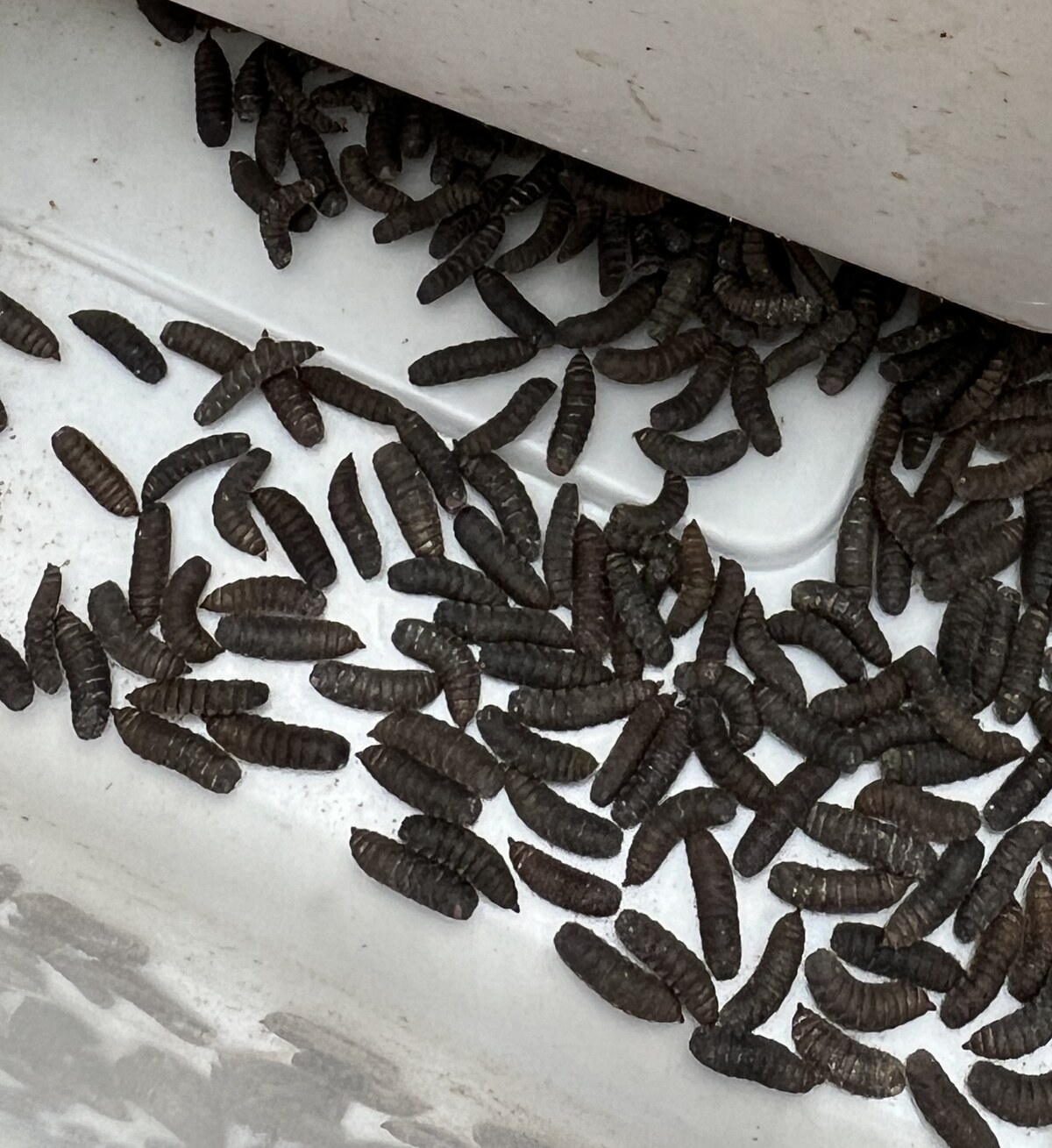
What changes between feed and larva
Comparing substrate fatty acids to larval fatty acids as if they were the same oil is an oversimplification. Deuterium-labeling work shows that medium-chain saturates—especially lauric acid (C12:0) and myristic acid (C14:0)—appear almost entirely as newly made molecules when those acids are missing from the diet. The acetyl-CoA for that synthesis comes largely from dietary carbohydrates, not from “copying” plant linoleic or linolenic acid (claim).
Palmitic and oleic acids sit in between: larvae both absorb them from feed and make them. The signature Hermetia pattern that poultry reviews call out—high saturated fat with a large lauric fraction—is therefore an insect metabolic product, not a leftover of kitchen oil (claim).
If you feed PUFAs, how much stays in the larva?
Black soldier fly larvae cannot meaningfully synthesize polyunsaturated fatty acids de novo. PUFAs in the body must come from the substrate. Retention is real but incomplete (claim):
- In a six-oil rearing trial, dietary shares of C16:0, C18:1n-9, C18:2n-6, and C18:3n-3 predicted larval shares with linear slopes of about 0.4–0.6—roughly half the dietary percentage appears in the larval fatty-acid pool, a bit higher when the diet is fatter (10% vs 5% supplemental oil).
- Across those diets, substrate PUFA spanned roughly 7–69% of fatty acids, while larval PUFA compressed to about 6–37%. Larvae still made 17–45% lauric acid even when most oils contained almost none.
- On a flax-cake diet rich in α-linolenic acid (ALA), prepupae held only about ~6% ALA of total fatty acids and metabolized on the order of two-thirds of that PUFA into saturates such as lauric and myristic. Flax-oil enrichment in other work raised larval ALA toward ~10% of fatty acids—higher than a plant-waste baseline, still far below a linseed oil.
Operator reading: feeding soybean oil, flax, fish offal, or algae does push more linoleic, ALA, EPA, or DHA into the larva, but Hermetia fat remains a partial carrier. Much of the dietary PUFA is burned or remodeled into the lauric-rich saturate pool. Tailoring long-chain omega-3 for aquaculture is possible; treating BSFL fat as a full fish-oil replacement is not.
Harvest timing shifts the profile
On food waste, larval fatty-acid mass tracks carbohydrate disappearance early, then leans more on substrate lipids later. Lauric acid tends to rise and linoleic to fall as larvae move toward prepupae, so a late harvest is usually more saturate-heavy than an earlier one (claim). If your goal is maximum lauric for a poultry functional-fat story, harvest near the plateau; if you are chasing residual dietary PUFA, earlier larvae can hold a higher unsaturated share—at the cost of yield and operator timing.
How much PUFA reaches chicken feed?
Downstream transfer is a two-step dilution: substrate → larva, then larva (or oil) → poultry ration (claim).
| Step | What happens to PUFAs | Planning cue |
|---|---|---|
| Substrate → larva | Partial bioaccumulation; large remodel into C12:0 / other SFAs | ~0.4–0.6× dietary FA share for C18:2 / C18:3; ~⅔ of ALA may be metabolized away |
| Larva → meal / oil | Full-fat meal keeps larval fat; defatted meal strips most of it; extracted oil concentrates the remodeled profile | Hermetia oil often ~15% PUFA vs soybean oil ~66% PUFA |
| Meal / oil → chicken diet | Inclusion % of the ration sets how much larval fat enters the bird | Immune-trial meal rates ~1–3% (w/w); oil trials often replace plant oil 50–100% |
| Diet → egg / meat | Product FA follow the feed fat: more SFA, less PUFA when HI fat displaces plant oil | Example: broiler breast PUFA ~37% → ~26% of FA with full soybean-oil replacement by BSFL fat |
Worked sketch for a PUFA-rich kitchen-oil substrate: suppose substrate fat is ~50% linoleic. Larvae might retain on the order of ~20–25% linoleic in their fatty-acid pool (slope ~0.5), while lauric still dominates. If you then feed 3% full-fat meal in a complete poultry diet, and the meal is ~30% fat, larval fat is only about 0.9% of the ration—so substrate linoleic contributes well under 0.3% of diet mass as that acid, before the rest of the formula’s corn and soy oils. In other words: feeding PUFAs to larvae does not flood chicken feed with those PUFAs; most of the story at practical inclusions is lauric-rich saturate plus whatever plant oils remain in the mash.
When trials replace soybean oil with Hermetia oil, the poultry diet fat itself becomes saturate-heavy, and eggs or breast meat shift the same way—higher SFA, lower PUFA—usually without wrecking growth or lay when diets stay isoenergetic. That is useful if you want medium-chain fat and lauric antimicrobial framing; it is the opposite of a PUFA-enrichment strategy for table eggs.
Practical takeaways
- Expect remodeling, not mirroring. Carbohydrate-rich waste drives lauric synthesis; oil-rich waste raises body fat and can lift PUFA share, but larvae still rewrite much of the profile.
- PUFA enrichment is partial. Use fish by-products or specialty oils only if you have a measured target (e.g. aquafeed n-3); do not assume kitchen PUFA passes through 1:1.
- Chicken-feed PUFAs are mostly the rest of the ration. At supplement rates used for enrichment or immune work, larval fat is a small slice of total dietary lipid. See BSFL as chicken feed for rates, egg quality, and Salmonella-challenge context.
- Formulate for the bird. Essential fatty-acid needs still come from the whole diet. Swapping plant oil for HI oil without checking linoleic/linolenic supply is a formulation error, not an insect feature.
Research trail: Lauric remodeling, PUFA retention, Chicken-feed downstream, Functional feed compounds.