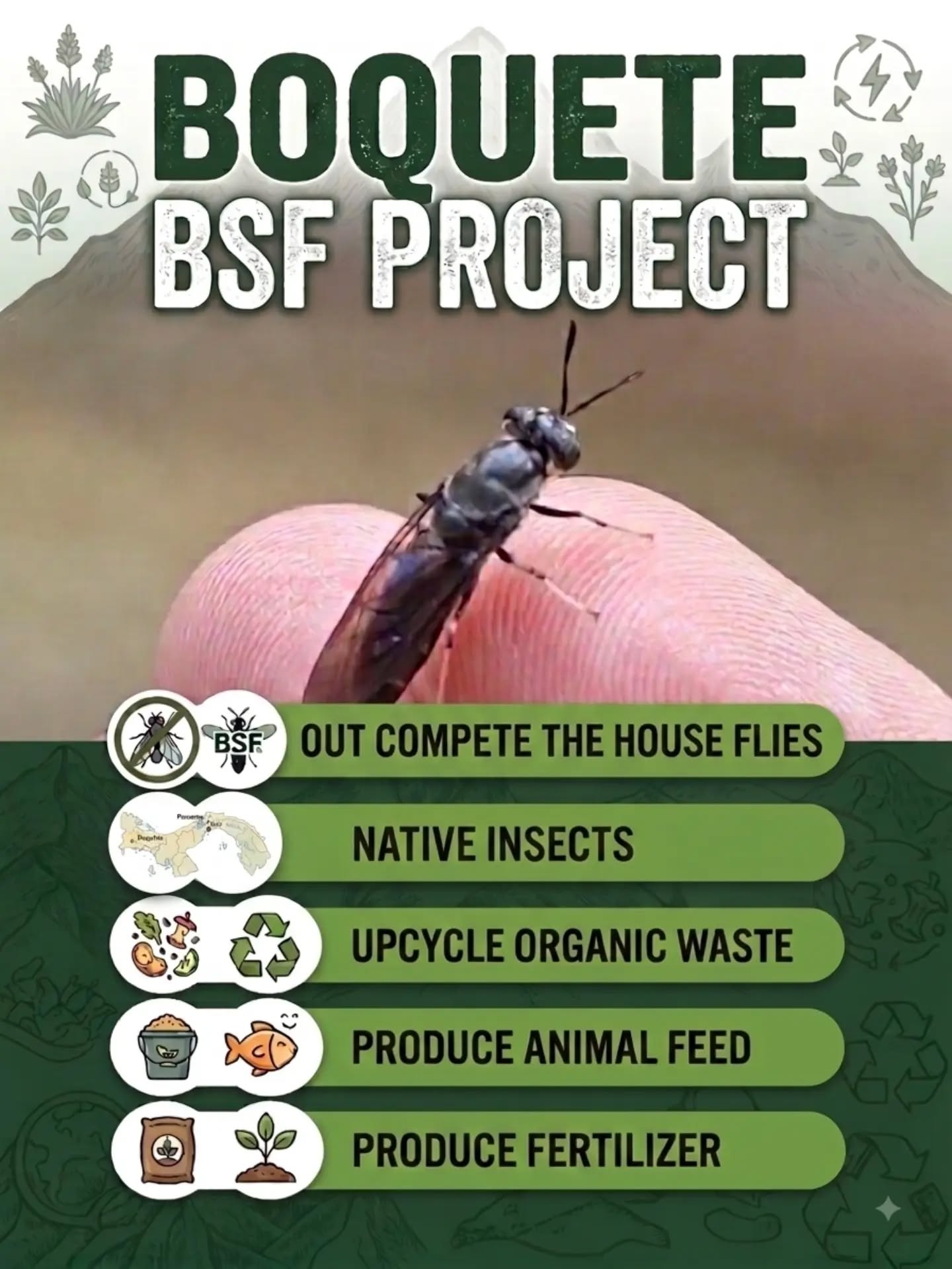
Not a house fly
Black soldier flies are true flies (order Diptera), but they are not the filth pests people mean when they say “fly.” Adults have no functional mouthparts for feeding on your food, they do not bite, and they are poor mechanical vectors compared with house flies. In a healthy system you mostly manage larvae, not buzzing adults indoors. Full comparison—people, disease, ecology, and aerobic vs anaerobic piles—in BSF vs house flies.
Why they matter
At wet organic waste, BSF larvae can outcompete house-fly larvae for food, cut odor and volume, and leave useful products: animal-feed biomass (where rules allow) and frass for soil. That is the core of the Boquete community pilot—and of every tank design on this site.
Life cycle
Warm conditions keep the cycle moving. Rough stages:
- Eggs — laid in dry cracks near wet food, not usually in the slurry itself.
- Larvae — the workhorses. Soft-bodied, cream to dark as they age; they grind through wet organic waste.
- Prepupae — larvae empty the gut, darken, and crawl away seeking a dry pupation site (often used as a self-harvest cue).
- Pupae → adults — adults mate and lay; they are short-lived and focused on reproduction, not feeding.
What the larvae eat
Larvae thrive on a wide range of wet organics—and they are especially impressive on dense animal streams. Meat, butcher trim, offal, and many manures are legitimate feeds when moisture and oxygen stay in range; colonies often process them faster and harder than a fruit-only diet. A bit of meat is also one of the strongest lures when trapping wild adults; bones left protruding from the bed give adults dry laying surfaces they prefer. Fruit and vegetable scraps, brewery and food-processing residues, mixed kitchen waste, and spent coffee grounds as a blend ingredient also work well.
They need moisture and oxygen; anaerobic, waterlogged piles fail. Avoid treating the tank like a dump for toxins, heavy metals, solvents, or waste you would not want in larvae or frass later. Local rules may limit selling or feeding larvae raised on manure or animal by-products—capability of the insect is not the same as feed-law clearance. Sorting detail: waste stream; tiers: economy roles.
What you get
In a typical BSF setup, the three main outputs are: larvae (harvestable biomass), frass (solid), and leachate (liquid). Waste reduction is the system effect you get alongside those outputs. Each output has a dedicated article: frass, leachate, frass tea (derived from solid frass).
- Waste reduction — volume and odor drop when loading matches larval appetite.
- Larval biomass — high-protein, high-fat larvae for animal feed where regulations allow ( chicken feed, fat profiles).
- Frass, leachate, frass tea — three distinct products; see Articles for detail.
Climate
BSF are warm-climate insects. Growth slows in the cold; colonies in temperate zones often need insulation, waste heat, or seasonal operation. Boquete and similar highland tropics still need attention to night temperatures and rain.
System idea
A digestion “tank” is a container that holds wet feed and larvae, separates solids (frass) from the draining liquid (leachate), keeps pests and vertebrates out, and—ideally—lets prepupae exit into a collection area. Some people also make a derived frass tea from steeping frass; that tea is a separate product from solid frass and from leachate. Scale from a 5-gallon bin to municipal lines uses the same biology; only engineering changes.
Next: Setup (seed a new bucket) · Designs · BSFL and worm compost · BSFL as chicken feed