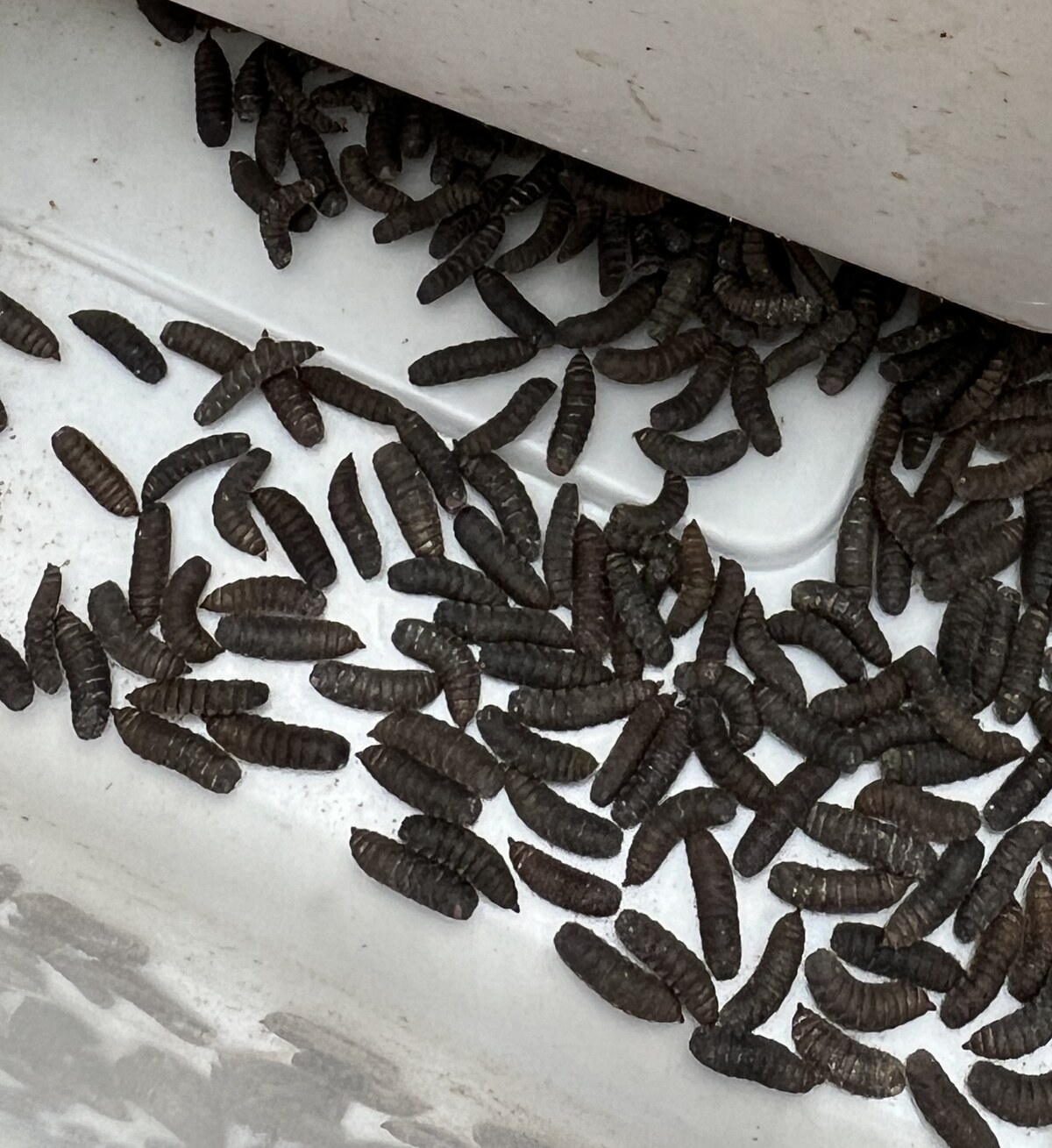
Why chickens eat larvae
Chickens naturally hunt insects. Black soldier fly larvae (BSFL) turn sorted organic waste into dense biomass that fits that behavior: high protein and fat, plus compounds reviews treat as functional—chitin from the cuticle, medium-chain fatty acids (notably lauric acid in Hermetia fat), and insect antimicrobial peptides (claim). Those extras help explain why low dietary inclusions can change immune and gut outcomes even when crude protein is already balanced. How larvae remodel substrate fat (and how little dietary PUFA survives into the ration) is covered separately in BSFL fat profiles.
On small holdings and community pilots (including chicken-yard cascades described in the waste-stream article), larvae are usually a supplement or enrichment on top of a complete ration—not a sole diet. Commercial trials use either live larvae (layers) or meal / oil mixed into feed (broilers).
Documented benefits
- Egg quality at practical live rates — Live BSFL at about 15–30% of expected daily feed intake (~15–38 g/hen/day) did not impair egg quality in layer trials; a planning mid of ~20 g live larvae/hen/day is useful for flock sketches (claim). Ad libitum (~160 g/hen/day) is not a default—it displaces concentrate and raises body weight.
- Immune markers and Salmonella challenge survival — Broilers fed 1–3% (w/w) BSFL in complete feed showed higher spleen CD4+ T-cell share, serum lysozyme, and lymphocyte proliferation. After oral challenge with Salmonella Gallinarum (fowl typhoid), survival rose to 67% / 75% / 85% at 1% / 2% / 3% BSFL versus 50% on control feed, with lower recoverable bacteria in liver, spleen, bursa, and cecum (claim). That is the study many people remember when they say larvae “give chickens resistance to Salmonella.”
- Growth and gut context (meal / oil) — Systematic reviews of Hermetia meal and oil for broilers report mixed but often neutral-to-positive growth when diets are properly formulated, with frequent notes of microbiota and innate-immune shifts tied to the same functional compounds (claim). Do not expect a single universal weight-gain bonus from any inclusion %.
- Behavior / enrichment — Live larvae give hens something to chase and peck. Layer studies that dose live larvae also track behavior and health alongside egg traits; treat foraging value as a real husbandry benefit even when production metrics stay flat (claim).
Read the Salmonella result carefully
Lee et al. (2018) challenged birds with S. Gallinarum—the agent of fowl typhoid—under experimental conditions. It is strong evidence that dietary BSFL can stimulate nonspecific immunity and improve clearance in that model. It is not:
- a field vaccine or a substitute for vaccination programs where they exist;
- proof against every Salmonella serovar (foodborne Enteritidis / Typhimurium are different problems);
- permission to feed dirty larvae or high-risk substrates into the flock.
Separately, some rearing studies show that larvae do not reliably sanitize a Salmonella-contaminated substrate by themselves. Keep feedstock hygiene and heat-preprocessing rules from the waste-stream article; do not outsource biosecurity to the insect.
How to feed (operator sketch)
Match form to the bird and the literature metric:
| Form | Typical use | Planning cue |
|---|---|---|
| Live larvae | Layer supplement / enrichment | ~15–30% of DFI fresh matter; mid ~20 g/hen/day |
| Dried / meal (low %) | Broiler additive in complete feed | ~1–3% (w/w) in the challenge study; higher meal replacements need ration reformulation |
| Oil | Energy + lauric-acid fraction | Study-specific replacement of plant oil—raises diet SFA / lowers PUFA vs soybean oil; see fat profiles |
Flock sizing from larval harvest is worked in
unit economics
(hens ≈ (larvae_kg_day × 1000) ÷ g_per_hen).
Weigh your own birds’ intake; backyard mixed flocks differ from trial genetics.
Regulations and honesty
Insect-to-poultry rules differ by country (substrate bans, processing, labeling). This page is evidence for operators and pilots—not legal advice. Where insects in feed are restricted, keep larvae in research or non-food animal channels until you confirm the local path.
Nutrient profiles follow larval diet, but fat quality is remodeled—not mirrored—by the insect. For lauric synthesis, PUFA retention fractions, and how little substrate PUFA reaches the mash, see BSFL fat profiles. Coffee-heavy or manure-linked substrates still change both fat quantity and contaminant risk; feedstock notes under economy roles and Boquete.
Research trail: Salmonella Gallinarum challenge, Live layer supplement rates, Functional feed compounds.