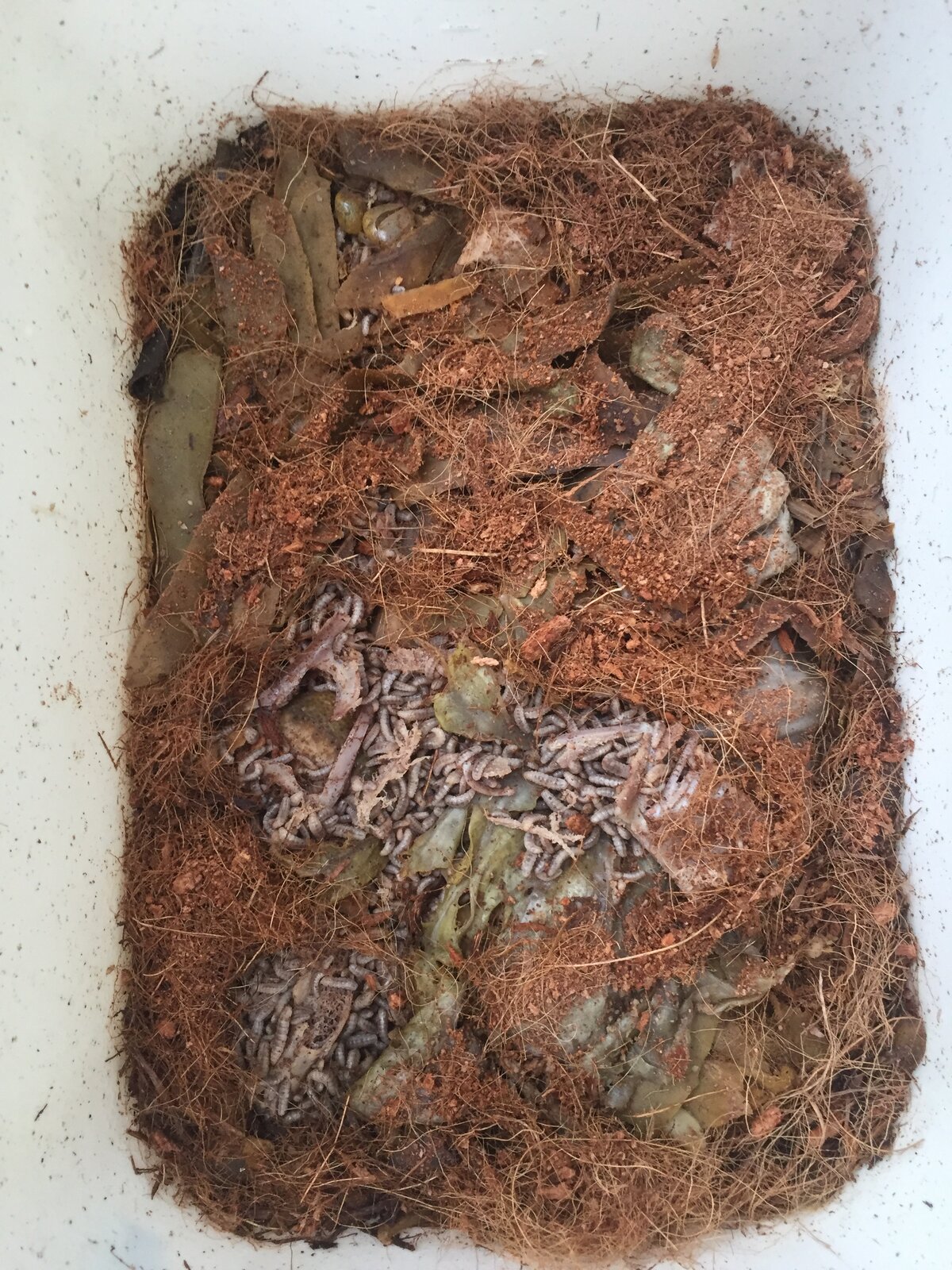
The tank design article covers geometry—ramps, drains, shade, pests. This page covers materials: the bucket, drum, tote, or frame you start from. Open hardware on this site assumes two common scales—the 5-gallon tilted drum and the 55-gallon tilted drum—but the trade-offs below apply wherever you build.
How to read this
Published manuals and extension guides often assume North American totes and new food-grade containers. In tropical field conditions—strong UV, daily rain bursts, limited retail stock—local sourcing wins. Pros and cons below mix general engineering notes with operator field notes from the Boquete BSF Project pilot in Chiriquí, Panama. Your mileage will vary; treat field notes as starting hypotheses, not guarantees.
Food-grade plastic buckets (~5 gal / 19 L)
White or colored HDPE buckets from restaurants, bakeries, and food processors are the cheapest entry point. They match the 5-gallon design without cutting a drum head.
Pros
- Very low cost — in Chiriquí, used food buckets often run about $2–4 USD each from restaurants (2026 field price).
- Lightweight — easy to move, drill, and mount on a simple leg frame.
- Easy to modify — hole saws, threaded bottle ports, and drilled drain clusters go in quickly compared with steel.
- Does not rust — important in humid, rainy climates if shelter is imperfect.
- Low thermal conductivity — plastic harvest surfaces stay cooler than bare metal in sun (see ramp material heat).
Cons
- Prior contents — buckets usually held cooking oil, sauce, or brine. Plan a serious wash (hot water, degreaser, repeated rinses) before feeding larvae.
- UV and embrittlement — even “food grade” plastic weathers in outdoor shade; micro-cracks appear at drill points and strap loads.
- Short service life — Boquete operators report buckets not lasting very long in Panama’s climate once drilled, loaded, and cycled—fine for learning and prototyping, less ideal as a permanent compound unit.
- Low capacity — one kitchen’s sorted scraps (~0.5 kg/day mid), not a café’s SCG stream (~8–10 kg/day) or a shared compound feed.
- Point loads crack shells — narrow pipe saddles concentrate stress; use wide cradle straps (called out in the 5-gallon build).
Best for: first tank, teaching, low-budget pilots, indoor or well-shaded trials.
HDPE plastic drums (~55 gal / 208 L)
Blue or white tight-head poly drums are common worldwide for liquids and syrups. They scale the same tilted-drum geometry as steel.
Pros
- More volume per shell — suited to a family compound or small food business on one 55-gallon frame.
- Drill-friendly — NPT bulkheads and weep grids without welding.
- No rust — leachate and humidity are less destructive than on bare steel.
- Lighter empty — easier to reposition during site tuning.
Cons
- Still UV-sensitive — large curved surfaces age; shade is mandatory, not optional.
- Shell flex — point loads from narrow saddles or over-tightened bands can oval the drum; use wide cradles.
- Heat in sun — big poly shells warm quickly; prepupae may avoid hot interior walls without roof cover.
- Food-grade sourcing varies — verify prior contents; reject unknown chemical drums.
Best for: operators with welding limited or unavailable, moderate throughput, good shade structure.
Steel drums and pails
Used 55-gallon steel drums and smaller steel pails are harder to find than restaurant buckets but can outlast plastic when welded into a proper frame—as in the all-steel compound build below.
Pros
- Durability — thicker shell, tolerates strap loads and daily operation longer than thin HDPE buckets in harsh sun.
- Weldable fittings — bosses, drain nipples, and frame tabs can be welded where plastic needs bulkheads.
- Expanded capacity at compound scale — one 55-gallon steel unit can absorb several kitchens’ organics when fed in batches.
- Pest resistance — rodents cannot chew through the shell (lids and vents still need mesh).
Cons
- Harder to source clean — in Chiriquí, food-grade steel drums are less common than restaurant buckets; expect hunting through suppliers and used markets.
- Rust — leachate, rain splash, and scratched drill edges need paint or coating; inspect exterior yearly.
- Heavy — frame must be braced; moving a loaded drum is a two-person job.
- Hot surfaces — bare steel in sun heats harvest paths; shade and interior plastic liners on ramps are worth considering.
- Skills and tools — the 55-gallon design assumes a welded leg frame; metalworking access is part of the cost.
Best for: family compounds, small processors, operators who want years of service and can maintain rust protection.
Plastic totes and crate stacks
Rectangular IBC totes and “larvero” crates appear in facility manuals (for example Eawag nursery dimensions). They palletize and stack for higher throughput.
Pros
- Footprint efficiency — flat sides simplify feeding stations and inspection.
- Modular scaling — add crates instead of building one giant vessel.
- Defined feeding geometry — published manuals specify crate sizes and stack spacing.
Cons
- Stack ventilation — without spacers, heat and humidity trap between layers (stack ventilation).
- IBC cage rust — metal cages on composite totes still rust; plastic bladder may be non-food if reused from chemicals.
- Higher unit cost than a used bucket in rural Panama—often imported or urban-sourced.
Best for: neighborhood hubs and facility-scale pilots with flat storage space—not the first Boquete backyard unit.
Wood and shallow tray builds
Low-tech Lab, extension totes, and North American amateur forums often show wooden boxes and shallow tray bins—wide, flat vessels with a PVC ramp. Wood is approachable with basic carpentry, and tray layouts are easy to photograph for blog posts.
Pros
- Local lumber — hardware stores everywhere; easy to repair.
- Custom sizes — any footprint that fits shade structure.
- Insulating — thick sides buffer day–night swings modestly.
- Flat inspection — shallow trays make it easy to see the whole bed at once.
Cons
- Everything organic is under attack — in the tropics, untreated wood, plywood ramps, and cardboard inserts rot, swell, and harbor insects fast. Termites, mold, and constant humidity are not edge cases—they are the default climate.
- Tray geometry drains poorly in heavy rain — wide flat bottoms pond leachate along corners and seams; see round vs tray below.
- Sanitation — porous grain harbors odor and house-fly eggs if not sealed.
- Heavier maintenance — expect periodic rebuilds; Boquete operators report that wood tray models copied from temperate-climate DIY guides did not work well here in Panama.
Best for: dry or temperate climates, fully enclosed sheds, or short prototypes—not the default recommendation for outdoor Chiriquí operation.
Round vs flat trays
Material and shape interact. Many North American amateur builds use rectangular totes or shallow trays because they are easy to buy and drill. In Panama’s wet season, round tanks and tilted drums drained better in field trials than flat tray layouts.
- Round shells — a bucket or drum on a tilt sheds liquid toward one low quadrant; there are no flat corners where water and leachate sit.
- Flat trays — even with a drain port, large horizontal areas hold puddles, especially when the unit is not perfectly level or when substrate shifts during feeding.
- Tropical rain — roof overflow, sideways rain, and nightly condensation add water you did not put in as feed; geometry that clears liquid quickly matters as much as material choice.
That drainage advantage is one reason the open designs on this site use tilted round vessels (5-gallon, 55-gallon) rather than flat tray bins—see also buckets vs climate trays. Cross-cutting drain rules are in the tank design article.
Field notes from Chiriquí
These observations come from operating in Boquete—not a controlled study. They explain why this site publishes both a bucket-scale and a drum-scale design.
- Restaurant buckets as the on-ramp. Used 5-gallon plastic buckets are everywhere in Chiriquí food service—cheap, immediate, and good for proving a local feedstock works. Budget time to wash out vegetable oil residue; degreasing matters for smell and pest pressure.
- Plastic buckets aged out quickly. In Panama’s UV and rain, drilled buckets became brittle and unreliable after relatively short outdoor service. They remain excellent trainers; they were not the long-term compound solution.
- Steel at compound scale. For a shared family compound, the Boquete pilot later preferred a welded all-steel 55-gallon build on the 55-gallon tilted-drum layout. Sourcing a clean used steel drum took more effort than finding buckets, but durability and capacity justified the trade for daily feeding volume.
- Wood tray builds from temperate DIY culture. Shallow wooden boxes and tray-style layouts shared by North American amateurs were tried early on and did not perform well in Boquete—organic materials (wood, ramps, inserts) succumb quickly to humidity, insects, and rot. The tropics treat anything organic as temporary.
- Round tanks for drainage. Compared with flat tray models, round buckets and drums on a tilt cleared leachate more reliably through Panama’s wet season. Good drainage is not optional here; it is part of keeping the bed aerobic and house-fly resistant.
- Shade regardless of material. Plastic or steel, open sun overheats substrate and harvest paths—see shelter notes.
If your community sees different lifetimes or prices, send field notes—material economics are local.
Choosing for your scale
| Scale | Typical material | Why |
|---|---|---|
| One kitchen, learning | Used 5-gal plastic bucket | Lowest cost; matches 5-gallon design |
| Family compound / small shop | 55-gal steel or HDPE drum on welded frame | Throughput and lifespan; see 55-gallon design |
| Neighborhood hub | Stacked crates or modular units | Throughput; modular stack unit |
Material choice is not permanent. Many operators start with plastic, learn feeding and harvest timing, then rebuild in steel or larger poly once the waste stream and maintenance rhythm are proven.
Research trail: Ramp material heat, Shade requirement, Stack ventilation. Field notes: Boquete BSF Project operator reports (2026).