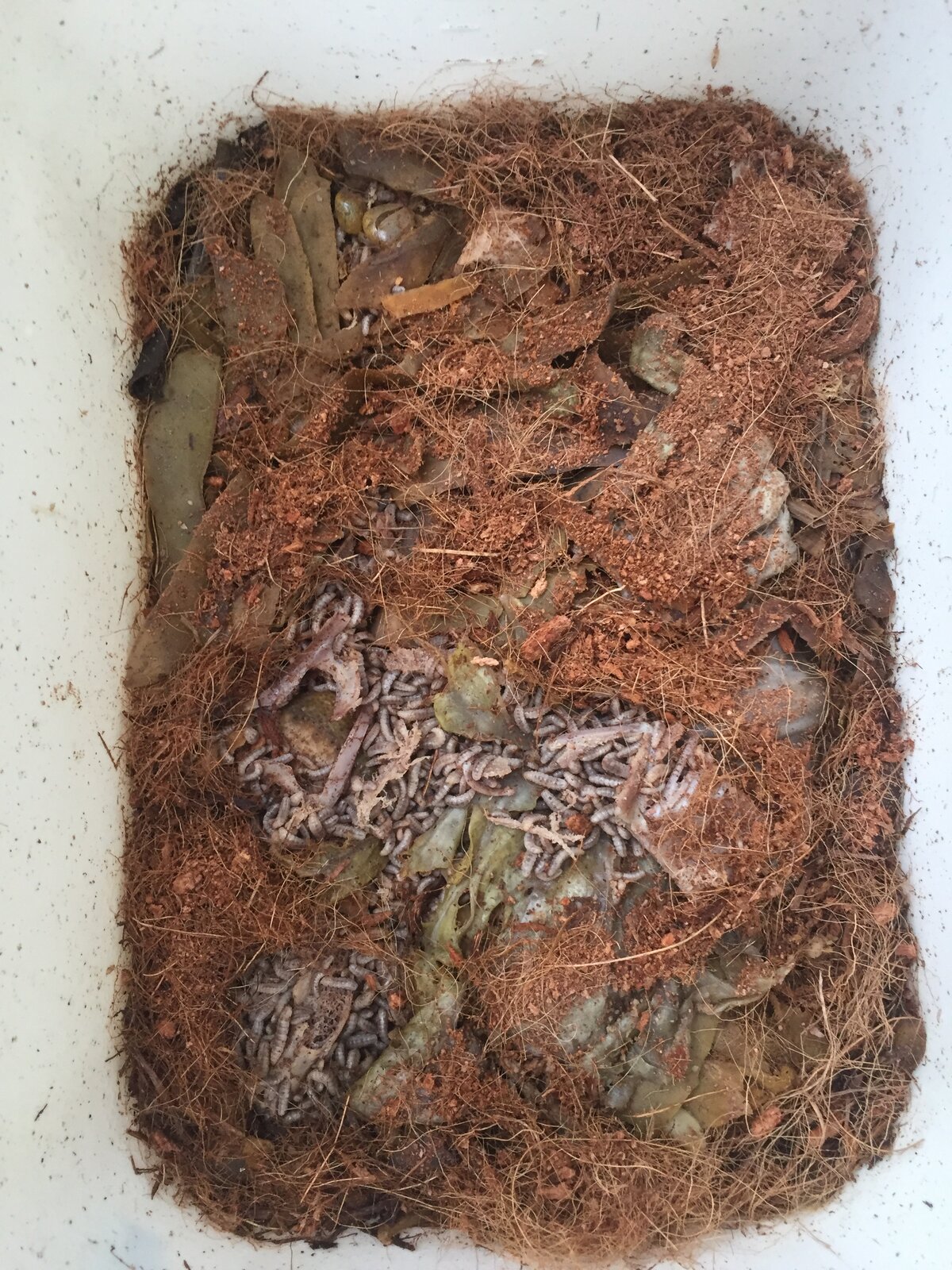
A BSF tank is a controlled place for larvae to eat wet organic waste, stay within useful temperature and moisture bands, and—when designed for it—deliver harvestable prepupae and separable solids and liquids. Scale-specific drawings, BOMs, and build docs live under Designs (see format policy); this article collects design rules that apply whether you build a bucket, a crate stack, or a drum-based hub.
Common vessel shapes
Published systems use several geometries, chosen for local materials and throughput rather than because one shape is universally superior:
- Boxes and crates — rectangular plastic totes and “larvero” crates are common in facility-scale guidance (for example ~35×55 cm nursery units in the Eawag manual) because they palletize, stack, and accept a defined feeding station.
- Trays and shallow bins — wide, low trays suit batch feeding and manual inspection; DIY builders often use tray-style bins with a full-width exit ramp. Climate-controlled tray halls are the commercial literature default—this site’s open-bucket ladder is a deliberate alternative (buckets vs climate trays).
- Round tanks and drums — 5-gal upcycled pails and 55-gallon drums suit households, family compounds, and small food processors; larger neighborhood or municipal layouts stack modules or use bigger vessels—geometry matters less than drainage, access, and harvest routing.
What matters across shapes is the same functional kit: a feed zone, optional ramp or collection path for migrating prepupae, liquid routing, ventilated cover, pest-resistant enclosure, and operator access for feeding and troubleshooting.
Harvest ramps and angles
When prepupae finish feeding they crawl away from moist substrate toward a dry, shaded pupation site. Many tanks exploit that behavior with self-harvesting: prepupae climb an exit ramp into a collection gutter, pipe, or nested container.
A literature review of deployed systems reports exit ramp inclinations from 28° to 45° as successfully tested. This project defaults near 36° (band 35–38°) for a stronger funnel / narrower crawl path; literature still spans 28°–45°. If someone says “about 30% incline,” check whether they mean 30° (within the published degree range) or a 30% grade (~17°), which is gentler than many cited exit ramps.
- Prefer a ramp wide enough that larvae following wall edges still find the exit (full-width ramps are a common DIY recommendation).
- Self-harvest works best when substrate moisture at end-of-cycle is high enough to trigger migration but the collection path stays climbable—migration timing is moisture-dependent.
- Some operators skip ramps entirely and nest the feeding container inside a collection container so prepupae fall over the rim; ramps are a convenience, not a law of physics.
- Use ramp materials that stay cool in sun—reported bin tests switched from aluminum to plastic because metal absorbed heat and prepupae refused to climb.
To harvest earlier larvae (before the prepupal crawl-off), use a manual or shaking sieve instead of a ramp. Eawag operational guidance cites ~3 mm mesh for manual sieving and ~5 mm for automated shaking sieves when separating larvae from residue.
Drainage and leachate
Wet feed produces liquid runoff as well as solid residue. Good tank design routes liquid away from the larval bed instead of letting the substrate sit in a anaerobic puddle.
- Plan a dedicated drain path or sump; capture liquid in a separate vessel for treatment or disposal. Open tilted-drum builds use a dense cluster of small–medium drilled holes at the low point—no interior mesh.
- Do not confuse that runoff with frass or frass tea—it is leachate, with different handling and claims.
- Side-mounted drainage can outperform bottom-only ports when bottom openings clog with substrate—field prototypes have moved drains for that reason.
- Engineered substrate moisture targets for larval feeding are often about 70–80% water content; drainage and feed blending work together to stay in band without waterlogging.
Aeration and stacking
Larvae need air exchange in the headspace above the substrate even though they avoid direct light. Covers are usually ventilated—mesh panels, perforated lids, or open frames—not airtight seals.
On open tilted drums and rack buckets, drill aeration holes on the sides and upper curve (mark at ~36° tilt) in addition to the low-corner leachate cluster. Keep aeration and adult ports off the ground-facing bottom curve so nothing drains or falls out. In the open-end / top third, use slightly larger ports (~7–9 mm, under 1 cm) on sides and upper only so adults can fly in and lay eggs. Collection / kitchen pails stay undrilled.
Facility layouts that stack multiple units use ventilation spacers between layers so air can move and moisture can leave the stack. Without that gap, stacked crates trap heat and humidity and make inspection harder.
Shelter from sun and rain
Larvae are photophobic: exposed feed drives them deeper into the pile, and prepupae seek shaded, protected pupation sites. Tanks belong under shade, a roof, or a ventilated shed—not in open midday sun.
- Target larval temperatures roughly 24–30 °C; overheated substrate sends larvae crawling away to cool off.
- Protect pupation and collection zones from rain that would wash prepupae off ramps or re-wet dry harvest paths.
- Adult mating cages are a separate design problem (light and flight space); conversion tanks focus on larval shade and stable microclimate.
Pest and rodent exclusion
Organic waste attracts house flies, birds, and rodents. Tank hardware is only part of the answer—facility hygiene matters too—but the vessel should help:
- Fine mesh or escape barriers on vents (while keeping airflow).
- Lids or covers that deny birds and mice easy access to feed.
- Structural exclusion at the building level: sealed bases, door sweeps, and no gaps where rats can reach larval crates—standard practice in published facility hygiene sections.
- Separate liquids and remove spoiled surface crust promptly; anaerobic, rotting pockets favor house-fly breeding over a managed BSF bed.
Operator access
Operators need to deposit waste safely, observe colony health, and recover from bad batches without dismantling the whole system.
- Feeding access — a hinged lid, front panel, or central feeding station where substrate is added without climbing into the tank.
- Inspection — enough opening to see moisture, smell, larval density, and pest intrusion; central feeding stations in multi-crate layouts allow per-unit checks during load.
- Stirring and troubleshooting — occasional mixing or surface scarifying breaks dry crusts and wet pockets; design clearance for a rake, paddle, or gloved hands without compromising mesh barriers.
- Harvest access — collection cups, transfer containers, and sieve stations reachable without contaminating clean prepupae with wet substrate.
Learn from existing builds
You do not need to invent every detail from scratch. Published DIY guides, extension sheets, and open manuals cover many of the same choices this article summarizes—ramps, drains, ventilated lids, and collection buckets. We link rather than mirror most of these; see our sourcing policy for why. Nothing below is an endorsement—useful reference points while you design your own hardware.
Open manuals and wikis
- Eawag BSF handbook (2nd ed.) — facility-scale crate dimensions, feeding stations, and sieve mesh sizes. Mirrored on this site (CC BY 4.0).
- IWMI practical guide (2024) — startup-to-harvest manual with container layouts and business context (CGIAR open access; link only).
- Low-tech Lab wiki — domestic breeding tutorial with a simple wooden box design, documented on the Nomade des Mers expedition (CC BY-SA).
University extension DIY guides
These 18-gallon tote + PVC ramp builds are widely copied. They are useful for ramp placement math, ball-valve drainage, and adult egg-lay ports—all rights reserved; link only.
- SDSU Extension — PVC ramp assembly; hole height ≈ 0.7× container length; optional drain valve.
- Purdue Extension E-276 — similar tote layout with ~35° ramp angle called out explicitly.
- USDA SARE PDF — photo-heavy companion to the extension lineage above.
Community and media builds
- Open Source Ecology how-to PDF — “grub tub” PVC ramp concepts and indoor breeding notes (student capstone on the OSE wiki; license unclear—link only).
- Grit magazine — gutter or PVC ramp at ~45° into a collection bucket.
- Gardening Australia — 70 L box, 30° PVC exit ramps, vermin-resistant lid (PDF instructions).
Commercial reference products
Off-the-shelf units illustrate design patterns cited in research and DIY guides—dual ramps, screened ventilation, leachate routing—without committing to a vendor. We have not received permission to reproduce product photos or manuals; manufacturer pages are link-only per our sourcing policy.
- ProtaPod BioPod Plus (ProtaCulture) — widely referenced dual-ramp harvest bin; often mentioned when comparing DIY layouts to a finished product.
If you operate a commercial product page and want it listed—or removed—reach us via Contributions. We add product links as public reference only, not as paid placement.
How this relates to open hardware on this site
Published tilted-drum designs instantiate these rules at two practical scales: 5-gallon tilted drum (small household, bucket on legs) and 55-gallon tilted drum (family compound or small food business, welded frame). Neighborhood hub: modular stack unit (5-gal columns + PVC drainage). Town concentrator (many banks beside dump logistics): Municipal. Use this article for the “why”; use a design folder for dimensions and assembly.
Research trail: Harvest ramp angles, Prepupal self-harvest, Substrate moisture target, Shade requirement, Leachate routing, Stack ventilation, Rodent exclusion, Sieve harvest mesh, Ramp material heat.