Role
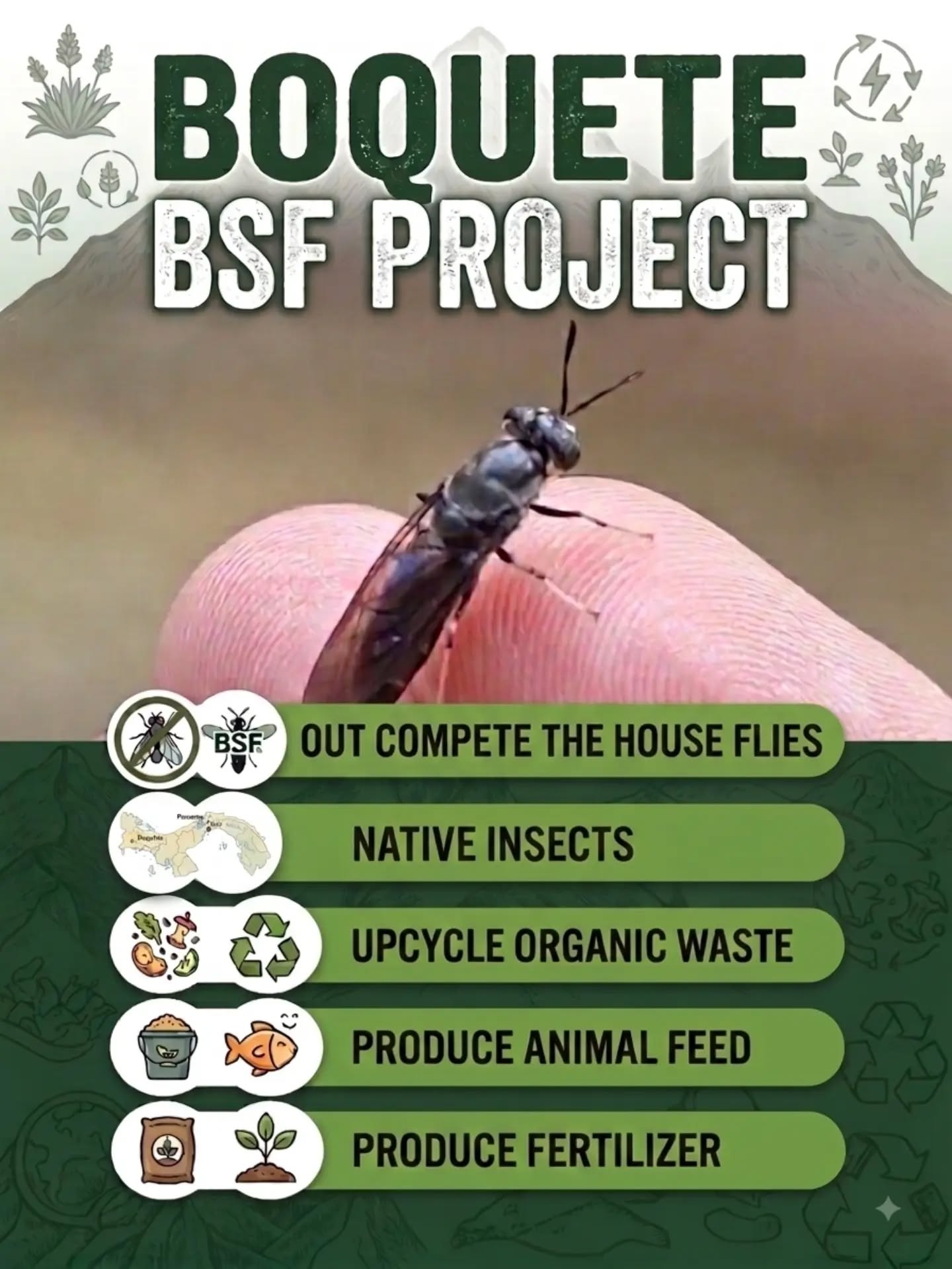
Boquete BSF Project is a community pilot: a place-based effort using native black soldier flies to upcycle organic waste, produce animal feed and fertilizer, and outcompete house flies at the waste stream. It is a reference implementation of the broader “registered community” category—not the whole global project.
In the BSF economy, the pilot exercises several roles at once: tank operator, organic waste supplier aggregation (cafés → spent grounds), R&D (SCG diet trials tied to the research hub), and yield consumers (local feed and fertilizer use). CapEx sketches: unit economics. Why open-air buckets here (not climate trays): buckets vs climate trays.
Week-to-week operations
A registered community runs a short loop operators can explain to neighbors—not a private farm diary. Typical weekly rhythm:
- Pickup / receive — intact collection buckets from partner cafés or kitchens (no drilled holes on the route).
- Dump and feed — empty into process modules (tilted 5-gal units or a modular rack); blend SCG with other wet organics—do not sole-diet on coffee.
- Harvest — empty underside PET bottles of prepupae; route to chickens or other allowed animals.
- Leachate and frass — empty trays/sumps; cure or compost solids; keep liquid out of “frass tea” marketing (leachate).
- Chicken-yard cascade — paper/carbon and residuals can layer into a deep-bedding run where land allows (waste stream).
Hardware on the ground
Start small, then stack—same process-module DNA at every step:
- 5-gal process module — patio / learning unit (cinder-block or welded stand).
- Modular stack / BANK-5G-8 — homestead or café-hub capacity (~19 kg/day mid per bank).
- Municipal ladder — many banks + logistics when routes prove out (cafés → coffee industry → restaurants → population).
- 55-gal drum — optional high-dump alternate, not the default path.
Photos and map
Until local CC-licensed or contributor-granted field photos land, this page uses draft flyer art and Commons biology elsewhere on the site. Prefer schematics for build dimensions. Policy: Commons / local CC / explicit grants only—no scraped social media, no private homestead dump. See graphics pipeline in the repo docs when publishing builds.
Focus
- Outcompete the house flies
- Native insects
- Upcycle organic waste
- Produce animal feed
- Produce fertilizer
- Integrate BSF with the chicken-yard deep bedding cascade
Relationship to the global project
Designs, biology guides, and the public platform live at the global layer. Boquete runs them on the ground and feeds practice back into open documentation. More communities can register alongside Boquete without replacing it.
Coffee partners (research-first)
Boquete has strong local coffee flows, so spent coffee grounds are a priority tier-A feedstock for the organic waste supplier role—clean, consistent, and well studied compared with manure or processing trim. Treat SCG as a blend ingredient, not a sole diet; fermented-SCG mix trials in the literature show best efficiency near ~20% inclusion under cited conditions. Logistics sizing: ~8–10 kg wet SCG per café per day mid default (claim)—then weigh local shops. Wet-process mills add seasonal pulp (~40–55% of fresh cherry mass, claim). Town path: municipal business-first.
Source trail: diet claim · café SCG volume · source catalog
Get involved
- Café or kitchen — sort a clean SCG or trim stream into labeled collection buckets; ask about pickup when routes expand.
- Builder / welder — fabricate from published designs; send field notes via contribute.
- Neighbor / flock owner — learn biology in the guides; larvae and frass use must follow local rules.
- Visit — this is a working pilot, not a drop-in tourist attraction. Contact through contribute (include a reply email) before showing up with a tour group.
Contribute · All communities · Waste stream · Biology guide · Designs