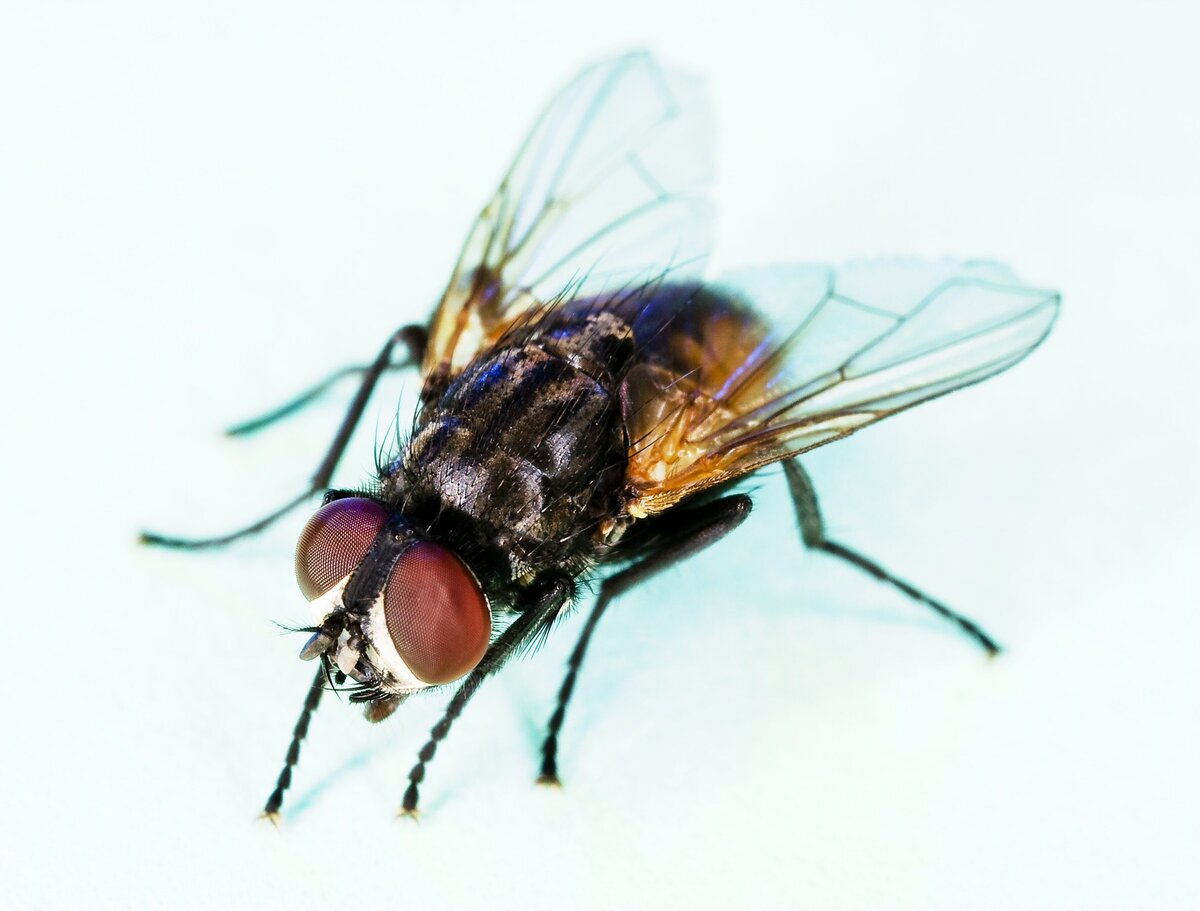
Two flies, two jobs
Black soldier flies (Hermetia illucens) and house flies (Musca domestica) are both true flies (Diptera). That is where the useful resemblance ends for operators. One is a warm-climate specialist that converts wet organic waste in managed bins; the other is a generalist synanthrope that breeds in rotting organic matter and then walks across kitchens, livestock, and wounds.
Public outreach often collapses every “fly” into one pest. This article separates adult behavior toward people, pest and disease roles, ecological niches (rapid response vs slower general composters), and how aerobic versus anaerobic conditions in the waste—and later in soil—change odor, hygiene, and how yields can be used. Life-cycle basics for BSF live in the biology guide.
How they interact with people
| Behavior | Black soldier fly | House fly |
|---|---|---|
| Bite / sting | No | No (annoyance is mechanical and hygienic, not venom) |
| Adult feeding | Adults do not feed on household food; mouthparts are not built for licking leftovers | Adults feed on liquids and soft organics—including food, feces, and secretions |
| Where adults go | Near breeding sites / mating areas; not classic indoor pantry pests | Readily enter homes, dairies, and kitchens; rest on people and surfaces |
| What people manage | Mostly larvae in a tank; adults are short-lived and reproduction-focused | Adults and larvae both feel like the problem—buzzing indoors plus maggots in trash |
| Operator posture | Invite and keep larvae where waste already is | Exclude, trap, and deny breeding sites |
In a healthy BSF system, neighbors should notice less rotting smell and fewer house flies—not a cloud of soldier-fly adults indoors. Adult BSF can still look alarming if people only know “flies” as pests; clear signage and the biology brief help. If adults are thick around a patio table, treat that as a site-design problem (exposed wet feed, poor lids, nearby unmanaged piles)—not as normal BSF behavior toward people.
Pests and disease
House flies are classic mechanical vectors. Adults move between filth and food, carrying microbes on legs, body, and regurgitated spit. Public-health literature treats M. domestica as a nuisance pest that can move enteric pathogens and other contaminants across surfaces people touch. That does not mean every landing fly causes illness—it means the species is built for that pathway.
Black soldier flies are a different risk profile. Adults are poor mechanical vectors relative to house flies: they are not food-seeking indoor pests, they do not bite, and day-to-day contact with people is limited if tanks are outdoors or in a work shelter. The hygiene questions that matter for BSF are mostly about feedstock and larval products—what went into the bin, and how harvested larvae or frass are handled before feed or soil use—not about adults walking across dinner plates.
- Do not treat BSF as “pathogen-free magic.” Contaminated feedstocks (heavy metals, certain toxins, poorly sorted animal by-products) can still matter for feed and soil pathways. Local rules for animal feed and manure-like materials apply.
- Do treat house-fly pressure as a process signal. Thick house-fly breeding usually means wet, anaerobic, poorly managed organic waste somewhere in the yard or route—exactly the conditions a well-run BSF tank tries to replace.
- Facility hygiene still matters. Rodents, birds, and open sumps can reintroduce pests even when larval beds are healthy—see tank and facility notes in tank design ((claim).
Bottom line for people: house flies are pests that interact with humans as disease-adjacent nuisances; BSF are managed converters whose human interaction is mostly “operator and neighbor,” not “kitchen invader.”
Place in the ecosystem
Waste piles are ecological stages, not static heaps. Different insects and microbes peak at different moisture, oxygen, and freshness windows.
Rapid response on wet putrescibles
BSF larvae are a rapid-response guild for wet, energy-rich organics—kitchen scraps, fruit pulp, meat and animal remains, many manures, café posos (spent coffee grounds) in blend, restaurant trim—when oxygen and drainage allow. They often thrive hardest on dense animal streams. They shred and mix substrate quickly, drop volume and odor, and convert biomass into larvae plus frass and leachate. That is closer to a high-throughput digester than to a slow leaf-mold compost pile.
Generalist filth and longer compost paths
House flies are generalist filth breeders. They exploit manure, garbage, spilled feed, and any anaerobic pocket that stays wet and rotting. They are not “the compost fly” in the helpful sense—they are opportunistic on whatever people leave unmanaged. Slower composters (fungi, earthworms, many detritivores) take over as material dries, stabilizes, and becomes more carbon-structured; BSF are not trying to replace that entire succession. A good backyard system often uses BSF for the wet flash, then garden compost / worm beds / chicken-yard cascades for the rest—see waste stream and BSFL and worm compost.
Competition, not coexistence as equals
Where BSF larvae establish densely in oxygenated wet feed, house-fly larvae usually lose the contest for that niche: less rotten slurry, faster turnover, less of the anaerobic surface house flies prefer. Where BSF loading fails (waterlogged bed, overloaded tank, exposed spills), house flies reclaim the stage. Operators should read house flies as feedback, not as a second “product stream.”
Soil microbiome: aerobic vs anaerobic
The difference people smell—and the difference that later lands on soil—starts as a microbial redox story in the waste itself.
In the bin
A healthy BSF bed is managed toward an aerobic (oxygenated) digestion flow: larval churning, drainage of excess liquid, shade without sealing the pile into a stagnant bag. Microbes under those conditions process organics with less of the sour, sulfurous profile of putrefaction. House-fly larvae, by contrast, are strongly associated with more anaerobic, rotting conditions—standing wet waste where oxygen is scarce and decay smells “wrong.”
That aerobic-versus-anaerobic framing is how this site explains house-fly outcompetition in outreach; the research hub still marks the comparative claim as needs-source until a specific primary study is mirrored (claim). Operational practice does not wait on that citation: drain leachate, avoid soup-like beds, match feed to appetite, and keep lids that block adults without killing airflow—see moisture and drainage notes in tank design (moisture claim, leachate claim).
What that means for people
- Odor and neighbors — aerobic BSF processing tends toward earthy / mild; anaerobic house-fly breeding sites tend toward putrid. Social license follows the smell.
- Hygiene pressure — fewer house flies around food and livestock means fewer mechanical transfers of filth microbes onto human surfaces.
- Workplace comfort — operators spend time near tanks; oxygenated beds are work you can stay next to.
What that means for yields and soil use
- Larval biomass — cleaner process conditions support the case for careful feed use where regulations allow (see BSFL as chicken feed). Anaerobic, fly-blown waste is not a feed story.
- Frass as soil amendment — solid frass from a well-drained BSF cycle is closer to a stabilized, oxygenated residue than to raw slurry. It still needs sensible rates and curing judgment; it is not identical to finished plant compost. Article: frass.
- Leachate — liquid drained from the bed must be handled as its own stream. Leaving it pooled recreates anaerobic pockets and invites house flies back. Article: leachate.
- Garden microbiome — applying products from an aerobic conversion pathway generally supports the goal of adding structured organic matter without dumping putrid, oxygen-starved sludge into planting beds. Dumping anaerobic sump juice or fly-maggot waste onto soil is the opposite pattern: odor, pest attraction, and a poor start for root-zone microbes that need air.
In short: BSF systems aim to keep the waste in an aerobic working state that people can live next to and that yields usable larvae and frass; house-fly ecology tracks the anaerobic failure mode of the same organics. Managing oxygen and drainage is therefore both pest control and product quality control.
Operator checklist
- Keep beds moist like a wrung sponge—not a puddle; drain leachate on schedule.
- Match daily feed to larval appetite; spills and overload breed house flies at the margins.
- Shade and shelter the tank; do not cook or drown the bed.
- Treat persistent house flies as a process fault (anaerobic pockets, open trash, nearby manure), not as “BSF attracting flies.”
- Separate yield streams: larvae / frass / leachate—and follow local rules before feed or soil use.
Research trail: Aerobic vs anaerobic house-fly context · Larval moisture target · Leachate separate from solids · Facility rodent / pest exclusion.