Schematics
Build from these drawings—not from marketing photos. Scroll the set; each figure is the measuring source.
Materials
Municipal rollout uses repeated modular banks. Materials for one bank: see the modular unit materials table.
Planning brief
Full rollout narrative: planning brief.
Overview
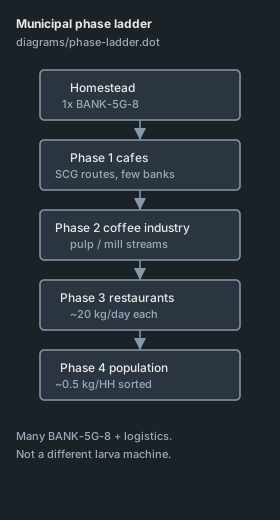
Municipal scale is operator logistics + many copies of the modular stack unit (BANK-5G-8)—not a different larva machine. The digestible path is business-first, not door-to-door households on day one.
Prove routes on cafés, expand through the coffee industry and ~100 restaurants, then open to the whole population. A dump-adjacent pad and complementary services grow with each phase.
Business-first rollout
Commercial kitchens and processors already sort and already use 5-gal pails. Planning defaults below are anchored to published waste studies where possible—see the research hub—then replace with contracts and weigh-ins. One BANK-5G-8 ≈ 19 kg/day mid; banks ≈ kg/day ÷ 19 (+ ~20% spare).
| Phase | Who | Wet kg/day (sketch) | Banks @ mid |
|---|---|---|---|
| 1. Cafés | 10–20 shops × ~8–10 kg wet SCG | ~80–200 | ~4–11 |
| 2. Coffee industry | Farms/processors — pulp ~40–55% of cherry mass | Throughput × pulp fraction (seasonal) | Tens–100+ at peak (after mill contracts) |
| 3. Restaurants | ~100 sites × ~20 kg sorted wet organics | ~2,000 (band 1,000–4,000) | ~105 (~126 with spare) |
| 4. Population | Households / district (~0.5 kg/HH sorted stream) | See ceiling below | Grow toward ~100–200+ |
Why this order: cafés prove the route; coffee industry is the seasonal volume lever (size from cherry tonnes × pulp fraction); restaurants are high kg/day per stop (~15–20 kg/day in Andean/tourism case studies); population opens only when commercial loops are boring. Full evidence table: business-first section and the planning brief.
- Café SCG ~8–10 kg/day — claim (Sydney survey ≈10 kg wet SCG/day)
- Restaurant ~20 kg/day mid — claim (Riobamba ≈18.5; Labuan Bajo ≈15.5)
- Household ~0.5 kg/HH BSF stream — claim (UNEP ≈79–88 kg/person/year)
- Coffee pulp ~40–55% of cherry — claim
Capacity planning
Mid feed default: 0.8 kg/module/day. Full formulas in the planning brief and modular capacity.
Ultimate scale (household ceiling)
Household default ~0.5 kg/HH/day sorted BSF stream—anchored to UNEP household food waste (~79–88 kg/person/year) for a ~3-person home, not the start line. Claim.
| Scenario | Wet kg/day | BANK-5G-8 @ mid |
+20% spare |
|---|---|---|---|
| Phase 1 cafés (10 × ~10 kg SCG) | ~100 | ~5× | ~6× |
| Phase 3 restaurants (~100 × 20 kg) | ~2,000 | ~105× | ~126× |
| Per 1,000 households @ 0.5 kg | 500 | ~26× | ~32× |
| Boquete district (~7,800 HH @ 0.5 kg) | ~3,900 | ~205× | ~250× |
| Boquete, ~50% of HH | ~2,000 | ~100× | ~125× |
Boquete ~23,500 district population (census 2023); household ÷3 and restaurant counts are planning sketches.
Facility sketch
Grow the pad with the phases—not a single jump to 200 banks:
- Site — start small; expand beside the town dump when Phase 2–3 volume justifies it.
- Pad — Phase 1: a few banks. Phase 3 mid (~20 kg/site): ~100–130 banks with spare. Phase 4: add households toward ~200+ under open-sided roof.
- Air / people — aisle fans as rows grow; same hub SOPs; route supervisors when restaurant count hits dozens.
- Services — unlock complementary intake with volume (below).
Complementary municipal services
Fold BSF into a holistic waste plan as phases unlock volume—not “everything in the fly bin” on day one.
| Service | Role | When |
|---|---|---|
| Sorted wet organics → banks | Core BSF feed | Phase 1 onward |
| Food-grade 5-gal upcycling | Collection + rack vessels | Phase 1–3 routes; public window in Phase 4 |
| Paper & cardboard → carbon yard | Browns with frass → soil; tear stock to seed new buckets | From first bank expansion |
| Public drop-off windows | Accept/reject education | Mainly Phase 4 |
| Larvae / frass outlets | Feed and soil amendment | From first stable harvest |
Bucket upcycling
The 5-gallon design scales by count. Collect empties on commercial routes; open a public upcycling window in Phase 4; wash and split collection vs rack pools. Detail: bucket upcycling.
Carbon processing
Paper/cardboard are not larval feed, but they are useful structure—including seeding new buckets. How-to: setup guide — seed pack (food + torn cardboard; larvae optional). Remaining carbon layers with frass into soil products. Detail: carbon processing.
Facility notes
- Open-sided roof; no climate-controlled building required for a first build-out.
- Power for fans and lighting (solar-friendly if the dump has limited grid).
- Shared leachate sump → tested disposal or treatment—see leachate.
- Rinse station + adaptation bench for upcycled buckets; dry storage for accepted empties.
- Covered carbon yard (shred/storage + compost pad) downwind of the banks; keep paper lanes separate from wet intake.
- Keep ~20% modules offline; batch-adapt in waves with bank commissioning.
- Phase: match banks to the business-first ladder (cafés → coffee industry → restaurants → population)—stand up the carbon pad when frass volume needs it.
Still to publish
- Site plan SVG (pad, complementary service bays, fan layout)
- Multi-bank BOM / electrical sketch
- Facility SOP (shift checklist, service accept lists)
Full planning brief: build guide.
License: CERN-OHL-P-2.0 · Design ID BSF-MUNI-BANK-FARM (facility drawings pending)