Drawings
Build from these drawings—not from marketing photos. Scroll the set; each figure is the measuring source.
Materials
Municipal rollout uses repeated modular banks. Materials for one bank: see the modular unit materials table.
Design: BSF-MUNI-BANK-FARM (facility layout — drawings pending)
Version: 0.1.0
License: CERN-OHL-P-2.0
Town- and city-scale organic conversion: many copies of the published modular stack unit (BANK-5G-8) plus collection logistics—not a different larva biology.
Bank hardware, PVC, and per-module constants: modular-unit capacity. Routes and sort: /articles/waste-stream/. Coffee feedstock: /articles/economy/, /communities/boquete/.
Concept
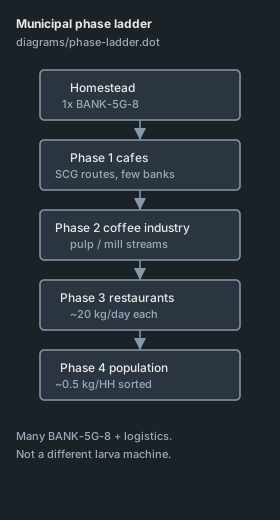
  Phase 1 cafés → Phase 2 coffee industry → Phase 3 restaurants → Phase 4 population
                              |
              +---------------+------------------+
              |               |                  |
        wet organics     paper/cardboard    used 5-gal buckets
        (BSF feed)       (carbon / soil)    (vessels)
              |               |                  |
              v               v                  v
         bank farm       carbon yard       wash / adapt shop
BSF farming is one node in municipal waste management—not a standalone factory. The practical path is business-first: cafés → coffee industry (farms, processors) → ~100 restaurants → whole population. Dump-adjacent pad and complementary services grow with each phase.
Business-first rollout (recommended)
Household collection is the hardest logistics and the messiest QA. Commercial sites already sort, already use 5-gal pails, and already expect pickup—start there. Illustrative Boquete-shaped numbers below are anchored to published waste studies where possible (research hub); replace kg/day with local contracts and weigh-ins before welding the next bay.
Constants: F_mid = 0.8 kg/module/day · one BANK-5G-8 ≈ 19 kg/day · blocks ≈ kg/day ÷ 19 (+ ~20% spare).
| Phase | Who | Feed sketch (planning) | Wet kg/day | Banks @ mid (+spare) | Evidence / what you prove |
|---|---|---|---|---|---|
| 1. Cafés | Town espresso bars / coffee shops | 10–20 sites × ~8–10 kg/day wet spent grounds (claim) | ~80–200 | ~4–11 (~5–13) | Route rhythm; SCG as blend not sole diet (economy) |
| 2. Coffee industry | Farms, beneficio/processors, larger roasters | Wet-process pulp ~40–55% of fresh cherry mass (~430–550 kg/t) (claim); seasonal | Throughput × pulp fraction (often 100s–1000s kg/day in harvest) | Size after mill contracts (commonly tens–100+ banks at peak) | Moisture/pulp QA; seasonal surge + dry-season café baseline |
| 3. Restaurants | ~100 food businesses in town | ~20 kg/day sorted wet organics / site (band 10–40; lit. means ~15–19) (claim) | ~2,000 (band 1,000–4,000) | ~105 (126); band 53–210 | Mixed kitchen trim, rejection rules, still commercial-only |
| 4. Population | Households / whole district | UNEP ~79–88 kg/person/year → ~0.22–0.24 kg/person/day; ~0.5 kg/HH/day sorted BSF stream for ~3-person HH (claim) | See ultimate scale | Grow toward ~100–200+ banks as participation rises | Public drop-off or residential organics; education; dump co-location |
Cumulative: each phase adds feed and banks. A café pilot fits a small roof bay; Phase 2 seasonal pulp and Phase 3 restaurants both push toward a dump-adjacent pad on their own—Phase 3 alone is already on the order of ~100 banks at the mid assumption. Phase 4 fills residential organics on top. Do not jump to population hardware on day one.
Evidence notes (planning defaults)
| Default we use | Literature anchor | Caveat |
|---|---|---|
| Café ~8–10 kg/day wet SCG | City of Sydney café survey: ~5.1 kg dry coffee/day × ~1.9 wet factor ≈ ~10 kg SCG/day; tourism-town café food waste ~5.6 kg/day | Small espresso counters can be ~3 kg; busy shops higher. |
| Restaurant ~20 kg/day | Riobamba, Ecuador ~18.5 kg/restaurant/day; Labuan Bajo ~15.5 kg/day; NZ café+restaurant mix ~7.9 kg/day (lower band) | Full-service dinner houses often 30–40+. Sort to BSF-suitable wet organics. |
| Household ~0.5 kg/HH/day BSF stream | UNEP FWI 2024: ~79 kg/person/year global HH average (~0.22 kg/person/day); UMIC ~88. ×3 people ≈ 0.65–0.7 kg/HH/day total food waste → ~0.5 as sorted BSF-suitable fraction | Not all HH food waste is larval feed. |
| Coffee pulp ~43–55% of cherry | Wet-process pulp dominant by-product; mucilage/parchment smaller | Size from tonnes cherries/day, not a fixed town-wide kg/day. |
Why this order
- Cafés — few stops, relatively clean grounds, brand-visible partners, same bucket SKU.
- Coffee industry — Boquete’s seasonal volume lever; processors already move wet pulp; BSF as industry co-product.
- Restaurants — ~100 accounts is still a route list, not a census; mixed trim is high kg/day per stop and trains QA before households.
- Population — public windows / residential organics only after commercial loops are boring.
Complementary services follow the same ladder: bucket upcycling with café/restaurant empties; carbon yard when frass volume rises; public drop-off mainly in Phase 4.
Capacity planning
modules_needed ≈ kg_day / 0.8
blocks_BANK8  ≈ modules_needed / 24
with_spare    ≈ blocks_BANK8 × 1.2
pad_m2        ≈ blocks_BANK8 × 4.4       # processing only; staging extra
Ultimate scale (household ceiling)
Household default: ~0.5 kg sorted BSF-suitable wet organics / household / day. Anchored to UNEP ~79–88 kg/person/year household food waste (~0.22–0.24 kg/person/day → ~0.65–0.7 kg/HH/day for three people), with ~0.5 as the larval-suitable planning fraction (claim). Band 0.3–0.8. This is the Phase 4 ceiling, not the start line.
| Scenario | Feed assumption | Wet kg/day | BANK-5G-8 @ mid |
+20% spare | Processing pad (no spare) |
|---|---|---|---|---|---|
| Homestead (livestock) — modular hub | 10–20 kg | ~15 | 1× | 1× | ~4.4 m² |
| Phase 1 cafés (10 × ~10 kg SCG) | café SCG | ~100 | ~5× | ~6× | ~22 m² |
| Phase 3 restaurants (~100 × 20 kg) | kitchen trim | ~2,000 | ~105× | ~126× | ~460 m² |
| Per 1,000 households | 0.5 kg/HH | 500 | ~26× | ~32× | ~115 m² |
| Boquete district (~23,500 pop, ~7,800 HH @ 3/HH) | 0.5 kg/HH, full | ~3,900 | ~205× | ~250× | ~900 m² |
| Boquete, ~50% of HH | 0.5 kg/HH | ~2,000 | ~100× | ~125× | ~440 m² |
Boquete population: ~23,500 (Panama census 2023, district). Household ÷3 and ~100 restaurants are planning sketches—verify locally.
Facility sketch (grows with phases)
| Piece | Sketch |
|---|---|
| Site | Start small (compound or rented bay); expand to a bay beside the town dump when Phase 2–3 volume justifies it |
| Pad | Phase 1: a few banks. Phase 3 mid case: on the order of ~100–130 banks with spare (~440–570 m² processing). Phase 4: add households toward ~200+ under open-sided roof as participation rises |
| Hardware | Repeat BANK-5G-8; batch-adapt modules; shared sumps—vessel supply |
| Air | Aisle fans as row count grows; shade + open sides (stack ventilation) |
| People | Same hub SOPs every phase; add route supervisors when restaurant count hits dozens |
| Services | Complementary services unlock with volume—not all on day one |
Complementary municipal services
If a town is interested in BSF farming, treat the banks as the wet-organics conversion core and add complementary services as phases unlock volume. Goal: holistic waste loop—protein and frass from larvae, soil from carbon + residuals, upcycled vessels—not “everything in the fly bin.”
| Service | What it does | When it tends to matter |
|---|---|---|
| Sorted wet organics → banks | Core BSF feed | Phase 1 onward |
| Food-grade 5-gal upcycling | Vessel supply for collection + racks | Phase 1–3 commercial routes; public window in Phase 4 |
| Paper & cardboard → carbon yard | Browns for composting with frass; tear stock to seed new buckets | From first bank expansion; scales with frass |
| Public drop-off windows | Accepted fractions + reject education | Mainly Phase 4 |
| Larvae / frass outlets | Local feed and soil amendment | From first stable harvest |
Detail for two high-leverage services follows. Expand as green waste or other pilots mature (waste stream).
Bucket upcycling (vessel supply)
The 5-gallon geometry scales by count. Commercial phases already generate empties; treat used food-grade buckets as program feedstock.
| Channel | Role |
|---|---|
| Café / restaurant pickup | Parallel stop on organics routes: clean empties (food, oil, beverage—not chemicals). Intact lids for the collection pool. |
| Public upcycling window | Phase 4 (or town recycling days): rinsed food-grade pails; post accept/reject rules. |
| Workshop bay | Wash → inspect → intact collection or adapted rack modules per 5-gallon BUILD. Keep pools separate. |
QA: accept food-grade edible/drink history; reject solvents, pesticides, unknown chemicals; never return drilled racks to a café line (modular unit).
At full Phase 4 (~100–200 banks) you need on the order of 2,400–4,800 active rack modules plus spares—upcycling beats retail-only stock. New purchases fill gaps.
Carbon processing (soil co-product)
Dry paper and cardboard are not larval feed, but they are useful structure—including a practical seed pack for new modules. Canonical how-to: /guides/setup/#seed-a-new-bucket (food + torn cardboard; a few active larvae are optional—they mainly add colony smells that help attract egg-laying adults).
At municipal scale, that is one more reason to run a cardboard line beside the banks: clean tear-stock for commissioning spares, plus browns for the deep-bedding cascade (waste stream).
| Stage | Sketch |
|---|---|
| Collection | Parallel lane for plain paper/cardboard (no plastic film or heavy coatings when possible). |
| Prep | Tear or shred; store dry; quarantine moldy loads. Keep a clean tear bin for module seeding separate from dirty compost-bound stock if needed. |
| Seed new modules | Follow the setup seed pack; use it every time you commission spare buckets or expand banks |
| Use with BSFL outputs | Layer remaining carbon with frass and wet residuals in windrows or deep beds. |
| Ultimate product | Stabilized soil amendment / compost—alongside larvae as protein. See /articles/frass/. |
Fiber recycling can still take clean loads when markets pay; the BSF site is the local co-product path, the browns frass needs, and the cardboard stash for seeding. Without carbon, dense banks push odor onto neighbors and module expansion gets harder.
Facility notes
- Roof: open sides; no climate-controlled building required for early phases.
- Power: fans + lighting; solar-friendly if grid is thin.
- Water / leachate: shared header → sump → tested disposal—
/articles/leachate/.
- Bucket shop: rinse + adaptation bench; dry storage for empties.
- Carbon yard: covered shred/storage + compost pad downwind; separate from wet intake.
- Spares: ~20% modules offline; adapt buckets in waves with each phase.
- Phasing: commission banks to match the business-first table—not a single jump to 200.
Still to publish
Report pilots via /contribute/ or a registered community (e.g. Boquete).
References
modular-unit · /articles/waste-stream/ · /articles/economy/ · /articles/unit-economics/ · /articles/frass/ · /articles/tank-design/ · 5-gallon · Boquete · /resources/research/