Drawings
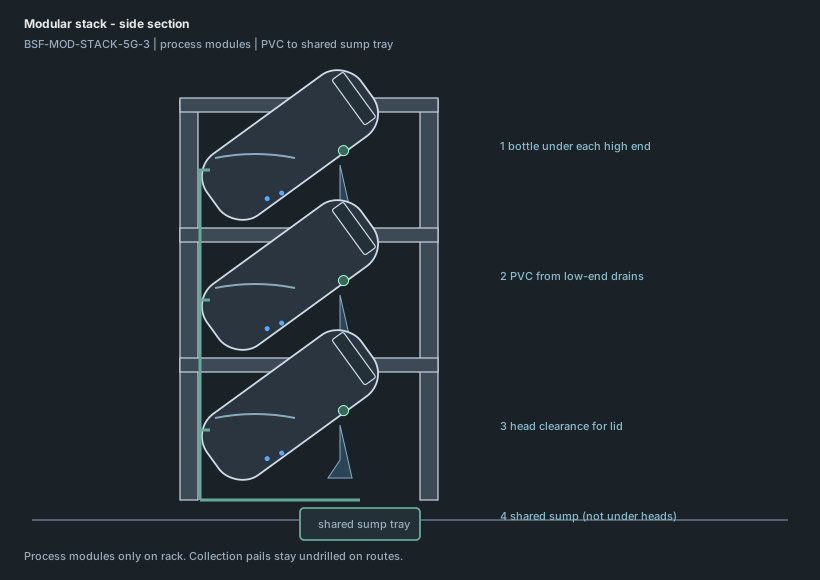
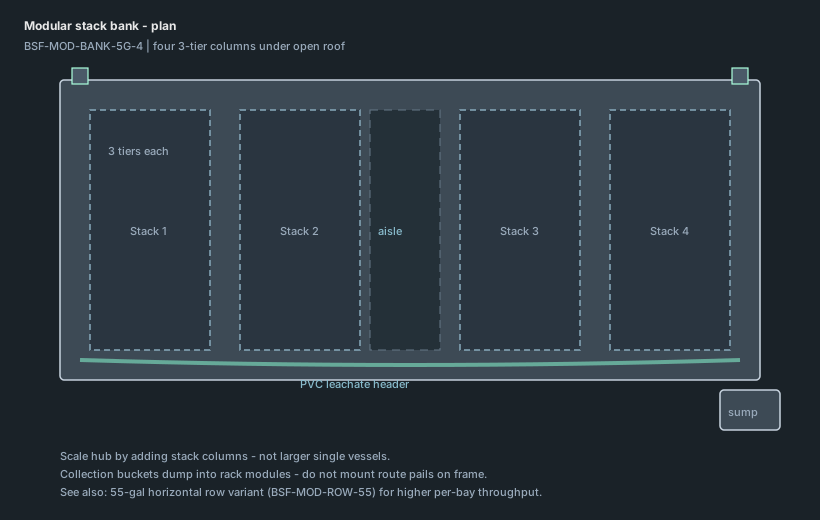
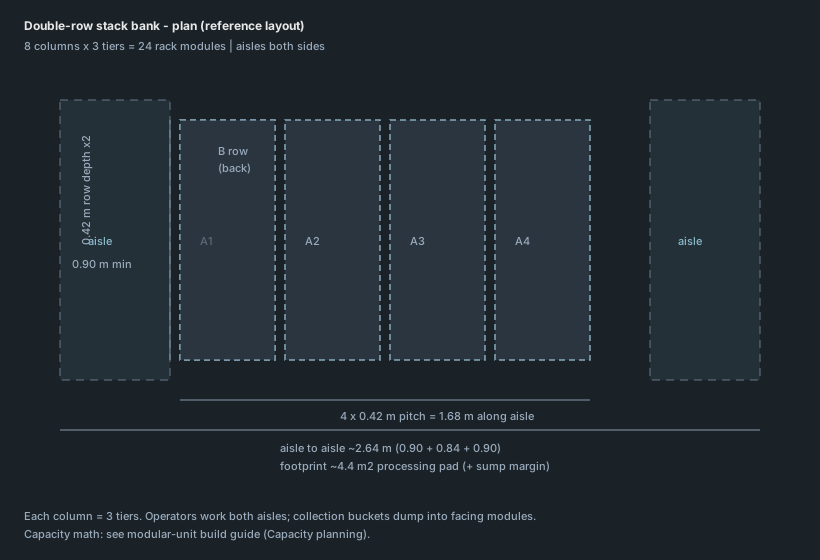
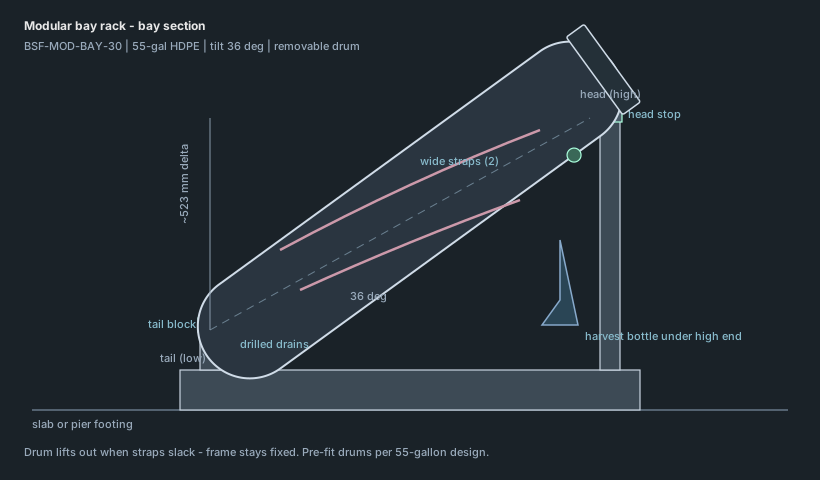
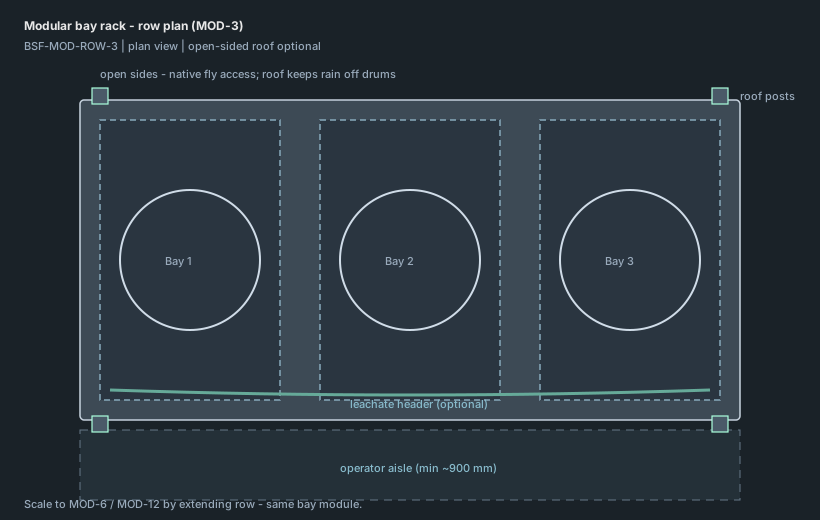
Build from these drawings—not from marketing photos. Scroll the set; each figure is the measuring source.
Materials
Gather these before you cut. Optional items use unit optional or qty 0 for notes.
| Qty | Unit | Item | Spec | Notes |
|---|---|---|---|---|
| 1 | each | Stack frame column 3-tier | Welded 50x50 mm posts + tier shelves + 36 deg open cradles | BSF-MOD-STACK-5G-3 |
| 6 | each | Cradle flat-bar rings per column | Upper+lower formed flat bar per tier (3 tiers x 2); bend on bucket form | Aluminum or mild steel stock bar; cheapest durable open cradle |
| 1 | lot | EPDM edge trim per column | Push-on EPDM (U-channel) on cradle contact edges; no glue | ~0.75–1.20 USD/ft sketch; UV/damp resistant |
| 3 | optional | Downhill rubber bumper per tier | Bolt-on stop if modules creep under vibration | Drill frame; stronger than adhesive neoprene |
| 3 | each | Rack module per column | Adapted bucket: rack bucket kit + lid kit | See /designs/5-gallon-rack/ and /designs/5-gallon-lid/ — not collection pails |
| 0 | each | Collection bucket per route | Standard food-grade 5-gal pail no holes | Separate inventory from rack modules |
| 1 | each | Rack module spare pool | N+1 adapted buckets per active column | Cheap to replace and re-adapt |
| 3 | each | Drain jumper per tier | Food-grade tubing to PVC tee | Quick-disconnect optional at tier swap |
| 1 | each | PVC downcomer per column | 32-40 mm PVC vertical with tees | Solvent weld; strap to frame post |
| 1 | each | Bank leachate header per row | 40 mm PVC sloped to sump | Min 1% grade |
| 1 | each | Sump | 20-60 L sealed or open with vent | Route to treatment - not crop tea without testing |
| 4 | each | Foot anchors per column | M10 expansion bolts | Bolt posts to slab |
| 1 | each | Roof post tab set | Bolt-on tabs for open-sided roof | Not a sealed building |
| 1 | each | Harvest bottle service per tier | 1-2 L PET on 28-400 adapter | Reach test for top tier |
| 0 | each | 55-gal bay row variant | See bay-section.svg + designs/55-gallon/ | Optional high-throughput alternate SKU |
| 0 | note | Cradle bend form | Fill spare 5-gal with cement; bend bar around outside of filled vessel | Slightly oversized OK; cardboard wrap for clearance; plastic may crack—mass matters |
| 0 | note | Avoid expanded-mesh cradle as default | Sags under wet load; traps grime | OK only if framed and lined; rings preferred |
| 0 | note | Avoid adhesive neoprene liner as default | Outdoor moisture kills adhesive | Use push-on EPDM instead |
Optional spreadsheet download: materials.csv
Design: BSF-MOD-STACK-5G-2 / STACK-5G-3 · BSF-MOD-BANK-5G-4 (assembly)
Alternate: BSF-MOD-BAY-30 / BSF-MOD-ROW-55 (55-gallon horizontal row)
Version: 1.3.0
License: CERN-OHL-P-2.0
Neighborhood- and town-hub scale for operator logistics: modular 5-gallon rack modules in a welded steel frame, stacked two or three tiers high, with PVC leachate routing. Uses the same standard bucket SKU as café pickup routes—but not the same physical bucket (see Collection vs rack).
Cross-cutting rules: /articles/tank-design/. Vessel prep: 5-gallon tilted drum (BSF-5G-TILT-30). Routes and buckets: /articles/waste-stream/.
Why 5-gallon stacks
| Concern | 55-gal horizontal row | 5-gal vertical stack |
|---|---|---|
| Full vessel lift | 150-200 kg; often two people or hoist | ~15-25 kg; one operator |
| Sourcing | Food-grade drums; harder to swap | Restaurant buckets everywhere |
| Pickup integration | Must dump bucket into drum | Bucket is the module |
| Footprint | Wide row | Narrow column, uses height |
| Drain plumbing | Per-bay hose or gutter | PVC manifold per column |
The 55-gallon horizontal bay rack remains a valid high-throughput variant when feed is dumped centrally and drums stay on site—see 55-gallon row variant below.
Concept
  [ roof - open sides ]
        |
   tier 3  (5-gal bucket module, 36 deg)
   tier 2
   tier 1  ----PVC tee----+
        |                  |
   steel frame posts       vertical drop
        |                  |
operator aisle header / sump| Part | Role |
|---|---|
| Steel stack frame | Posts + tier shelves; cradles at 36 deg; bolt to slab |
| Rack module | Adapted bucket per 5-gallon BUILD—drilled, access lid, harvest port |
| Collection bucket | Standard food-grade pail, intact lid, no holes—pickup route only |
| PVC drain system | Barb/tee from each tier low drain to column downcomer to shared header |
| Sump | Collection tank; not crop tea without testing |
Inventory N+1 rack modules per active column (prepped spares). Collection buckets stay on the route; operator dumps them into rack modules at the hub.
Collection buckets vs rack modules
5-gallon buckets are standard, cheap, widely available, and multi-use. That is the material advantage—not that one pail does every job without modification.
| Role | Prep | Stays where |
|---|---|---|
| Collection | No drill holes; lidded transport | Restaurant, truck, swap for clean empty |
| Rack module | Drain weeps, harvest port, access lid, optional drain barb | Cradle on stack frame |
Do not mount a restaurant collection bucket on the rack—it lacks drains, harvest geometry, and will leak or fail harvest. Do not return a drilled rack module to a café unless you have a clear re-certification story (default: keep pools separate).
Adaptation workflow (hub workshop or local manufacturer):
- Source new food-grade 5-gal pail.
- Wash; verify prior contents.
- Drill per
5-gallondrawings (drain cluster, underside harvest bulkhead).
- Fit bottom-hinged stock lid on head (no latch).
- Optional: barb fitting for PVC jumper.
- Label as rack module; log in spare inventory.
Damaged units on either side are cheap to replace: new stock bucket + same adaptation steps for rack modules; new collection pail for routes.
Stack geometry (inherits 5-gallon)
| Parameter | Value |
|---|---|
| Vessel | US 5-gal (19 L) bucket or pail; food-grade |
| Tilt per tier | 36 deg +/- 3 deg |
| Tiers per column | 2 or 3 (MOD-STACK-5G-2 / STACK-5G-3) |
| Tier spacing | Bucket swept diameter + ~80 mm clearance for bottle service |
| Cradles | Preferred: upper + lower formed flat-bar rings + push-on EPDM edge trim; head stop at upslope (see Open cradle) |
| Frame load | Rate for 3 x full bucket + substrate per column (~75 kg minimum design load with margin) |
Reuse tilt math from 5-gallon (~216 mm leg delta on a single unit at 36°).
Open cradle
Open-top cradles hold the process module at 36° without enclosing the shell. Choose structure and liner for cost, build ease, and damp durability (leachate, humidity, wash-downs).
Structure: flat-bar rings (preferred) vs expanded mesh
| Feature | Formed flat-bar rings (upper + lower) | Expanded-metal mesh basket |
|---|---|---|
| Cost | Lowest (stock aluminum/steel flat bar; sketch ~$5–12 / cradle) | Higher (sheet cutoffs often ~$15–30+) |
| Build | Easy — bend around a pipe or bucket form; drill bolt holes | Harder — sharp edges need grinding; sheet bends carefully |
| Stability | High — two rigid half-rings at rim and lower body | Moderate — thin mesh can sag under ~15–20 kg wet module unless framed |
| Durability / clean | Excellent — solid bar washes off | Mesh traps grime and wet compost |
Default: upper and lower formed flat-bar rings bolted or welded to the tier shelf at 36°. Add a head stop so the bucket cannot slide downhill past the tilt. Do not rely on a floppy mesh basket alone for bank racks.
Anti-slip liner
| Option | Verdict |
|---|---|
| Push-on EPDM edge trim | Preferred — clips onto the bar edge (no glue); UV/weather/damp resistant; sketch ~$0.75–1.20 / ft |
| Self-adhesive neoprene strips | Cheap short-term; adhesive fails outdoors with moisture, heat, and leachate |
| Bolt-on rubber bumpers | Strong mechanical lock against downhill slide; needs extra drilled holes |
Default liner: push-on EPDM edge trim on the contact edges of both rings. Optional bolt-on bumper at the downhill (low) side if modules still creep under vibration.
Bending form (field mandrel)
You do not need a machined mold. A little oversized radius is better than tight—restaurant pails vary, and a loose cradle plus EPDM still holds at 36°.
Preferred DIY form: take a spare food-grade 5-gal bucket, fill it with cement (or packed wet sand if cement is scarce), and bend the flat bar around the outside of the whole vessel—not a cement plug pulled out of the shell. The plastic may crack or UV-age; the mass inside keeps the cylinder from ovalizing while you lever or hammer the bar. Leave the filled bucket as a permanent shop mandrel.
| Tip | Why |
|---|---|
| Wrap 1–2 layers of cardboard or carpet on the form before bending | Intentional clearance for fat/ribs/non-standard ODs |
| Mark upper vs lower ring height on the form | Rim ring vs lower-body ring sit at different stations |
| Deburr bar ends before EPDM | Trim seats cleaner; less cut risk |
| Optional later: steel pipe ~ bucket OD, or plywood disks | Faster for batch builds—not required for first racks |
Empty thin-wall buckets alone crush under bending force—fill them. Expanded-mesh still is not the default cradle even with a good form.
  head (high) →                    ← tail (low)
       [ head stop ]
            U  flat-bar ring (upper, near rim) + EPDM
           / \
          |   |  5-gal process module @ 36°
           \ /
            U  flat-bar ring (lower) + EPDM
Standalone welded stands can use the same ring+EPDM recipe; cinder-block patio hacks still pad with hose scrap / cardboard (see 5-gallon stand options).
PVC drainage
- Each tier: low-quadrant drain from 5-gal module with hose barb or bulkhead facing the frame centerline.
- Flexible short jumpers (food-grade tubing) tier to PVC tee on vertical downcomer.
- Downcomer: 32 mm (1-1/4 in) or 40 mm (1-1/2 in) PVC along frame post to bank header.
- Bank header: sloped PVC pipe (min 1% grade) to sump—open top or sealed with vent.
- Service: flush header monthly; inspect tees when swapping modules.
Keep leachate separate from harvest bottles and frass—see /articles/leachate/.
Tray / sump SOP
| Layout | Capture | Empty / clean |
|---|---|---|
| Standalone 5-gal | Shallow pan under low-end drain cluster | Slide out daily–weekly; rinse; never pour into harvest bottles |
| Modular column | Tier jumpers → PVC drop → shared sump/tray at header end | Dump sump on schedule; flush header monthly; keep aisle dry |
| Clearance | High end free for hanging bottle + hanging-open lid | Do not raise sump under the head |
Municipal pads still use many BANK-5G-8 copies; each bank’s header/sump is part of the facility sketch—not a different larva machine.
Stack SKUs
| ID | Layout | Typical use |
|---|---|---|
| BSF-MOD-STACK-5G-2 | 1 column, 2 tiers | 2 modules · ~1.6 kg/day mid |
| BSF-MOD-STACK-5G-3 | 1 column, 3 tiers | 3 modules · ~2.4 kg/day mid |
| BSF-MOD-BANK-5G-4 | 4 columns x 3 tiers | 12 modules · ~10 kg/day mid · ~2.2 m² |
| BSF-MOD-BANK-5G-8 | 8 columns x 3 tiers | 24 modules · ~19 kg/day mid · ~4.4 m² |
Scale the hub by adding stack columns under one roof—not enlarging a single vessel.
Capacity planning
Scale by multiplying units → columns → racks. Constants below are planning defaults—replace with field measurements from your hub.
Constants (planning defaults)
| Symbol | Value | Meaning |
|---|---|---|
V_nom |
19 L | Nominal 5-gal shell per rack module |
V_act |
8.5 L | Active wet bed per module (~45% of shell at steady state) |
F_lo |
0.5 kg/day | Wet feed per module — conservative (learning / dilute coffee blend) |
F_mid |
0.8 kg/day | Wet feed per module — mid (mixed trim, hub planning default) |
F_hi |
1.2 kg/day | Wet feed per module — aggressive (dense, well-managed) |
T |
3 | Tiers per column (MOD-STACK-5G-3) |
P_col |
0.42 m | Column pitch along aisle |
D_row |
0.42 m | Row depth (aisle to back of column) |
W_aisle |
0.90 m | Aisle width |
Modular formulas (modules = columns × tiers):
V_nom_total  = modules × 19 L
V_act_total  = modules × 8.5 L
F_lo/mid/hi  = modules × 0.5 / 0.8 / 1.2 kg/day
Substrate volume ≠ daily throughput. Larvae limit kg/day; stored bed volume is biology holding capacity.
Per unit — one rack module
One adapted 5-gal bucket in a cradle (5-gallon prep). Smallest counting unit. Feed profiles (coffee vs animal tailings): 5-gallon capacity.
| Metric | Value |
|---|---|
| Modules | 1 |
Nominal shell (V_nom) |
19 L |
Active wet bed (V_act) |
~8.5 L |
| Wet feed/day | 0.5 / 0.8 / 1.2 kg (lo / mid / hi) |
| Plan footprint share | Stacked in column — see column row |
Per column — MOD-STACK-5G-3
One vertical stack (3 tiers, single plan footprint). Design ID BSF-MOD-STACK-5G-3. Two-tier variant STACK-5G-2: multiply unit row by 2 instead of 3.
| Metric | Formula | Value (3 tiers) |
|---|---|---|
| Modules | T |
3 |
| Nominal volume | T × 19 L |
57 L |
| Active wet bed | T × 8.5 L |
~26 L |
| Wet feed/day (lo / mid / hi) | T × F_* |
1.5 / 2.4 / 3.6 kg |
| Plan footprint | P_col × D_row |
~0.42 × 0.42 ≈ 0.18 m² |
Per rack — assembly of columns
A rack is a welded frame section operators treat as one install unit. Two reference SKUs:
MOD-BANK-5G-4 — single-sided row (4 columns × 3 tiers, one aisle + columns):
| Metric | Formula | Value |
|---|---|---|
| Columns | 4 | 4 |
| Modules | 4 × T |
12 |
| Nominal volume | modules × 19 L |
228 L |
| Active wet bed | modules × 8.5 L |
~102 L |
| Wet feed/day (lo / mid / hi) | modules × F_* |
6 / 10 / 14 kg |
| Processing footprint | (4 × P_col) × (W_aisle + D_row) |
~1.68 × 1.32 ≈ 2.2 m² |
MOD-BANK-5G-8 — double-row, back-to-back (4 + 4 columns × 3 tiers, aisles both sides). See drawings/stack-bank-double-row.svg.
| Metric | Formula | Value |
|---|---|---|
| Columns | 4 + 4 |
8 |
| Modules | 8 × T |
24 |
| Nominal volume | modules × 19 L |
456 L |
| Active wet bed | modules × 8.5 L |
~205 L |
| Wet feed/day (lo / mid / hi) | modules × F_* |
12 / 19 / 29 kg |
| Processing footprint | (4 × P_col) × (2×W_aisle + 2×D_row) |
~1.68 × 2.64 ≈ 4.4 m² |
| With sump / margin (~15%) | ~5.1 m² |
Scale racks: N double-row blocks → N × 8 columns, N × 24 modules, N × 4.4 m² processing pad (before margin).
Summary ladder (mid feed F_mid)
| Level | SKU example | Modules | Active bed | Feed/day (mid) | Footprint |
|---|---|---|---|---|---|
| Unit | 1 bucket | 1 | ~8.5 L | 0.8 kg | (in column) |
| Column | STACK-5G-3 | 3 | ~26 L | 2.4 kg | ~0.18 m² |
| Rack (single row) | BANK-5G-4 | 12 | ~102 L | ~10 kg | ~2.2 m² |
| Rack (double row) | BANK-5G-8 | 24 | ~205 L | ~19 kg | ~4.4 m² |
| 2× double-row racks | 2 × BANK-5G-8 | 48 | ~410 L | ~38 kg | ~8.8 m² |
Per m² floor (double-row rack basis)
Divide MOD-BANK-5G-8 totals by 4.4 m²:
| Metric | Per m² |
|---|---|
| Modules | ~5.4 / m² |
| Nominal volume | ~103 L/m² |
| Active wet bed | ~46 L/m² |
| Wet feed/day (lo / mid / hi) | ~2.7 / 4.3 / 6.5 kg/(m²·day) |
Reference feed examples (mid case)
| Hub layout | Modules | Mid feed/day |
|---|---|---|
| 1 column (3 tier) | 3 | ~2.4 kg |
| MOD-BANK-5G-4 | 12 | ~10 kg |
| MOD-BANK-5G-8 | 24 | ~19 kg |
| 10 cafés × ~10 kg wet SCG | — | ~100 kg → ~5 × BANK-5G-8 (café SCG claim) |
| ~50 m² double-row pads | ~290 modules | ~230 kg |
| ~100 m² double-row pads | ~580 modules | ~460 kg |
Not pinned research claims—ramp feed to observed consumption. See substrate moisture target.
Sanity checks:
- Larval biomass must match feed—overfeeding causes anaerobic beds (aerobic vs house-fly claim).
- Leave ~20% module spare offline when sizing racks.
- Collection-bucket dump/rinse zone is extra floor beyond processing footprint.
Hub deployment reference
How far one modular install typically goes before you leave this design for a multi-bank facility. Uses F_mid (0.8 kg/module/day) unless noted. Town / dump-adjacent programs: /designs/municipal/.
Homestead — one BANK-5G-8
A family homestead that converts farm offal, spoiled fruit, and slaughter trim into larvae for pigs/ducks/chickens typically lands in a 10–20 kg/day planning band (peaks higher on slaughter weeks).
| Item | Planning value |
|---|---|
| Steady wet input | 10–20 kg/day (peaks 25–35 kg/day in strong offal/fruit season) |
| Target hardware | 1× BANK-5G-8 (24 modules) |
Mid capacity (F_mid) |
~19 kg/day |
Animal-tailings band (1.2–1.8 kg/module/day) |
~29–43 kg/day — common once beds are mature (5-gallon feed profiles) |
| Processing pad | ~4.4 m² (+ ~15% → ~5 m²) |
| Under-roof footprint (rack + tote staging + aisle) | ~12–16 m² |
| Offline spare | ~20% modules (~5 buckets) |
If steady feed stays below ~15 kg/day, a single BANK-5G-4 (12 modules, ~2.2 m²) is enough until volume is proven. Typical phased path: 3–4 standalone tilted drums → migrate into BANK-5G-4 → expand to BANK-5G-8.
Neighborhood café hub
Ten cafés × ~10 kg/day wet SCG ≈ 100 kg/day ≈ ~5× BANK-5G-8 (café SCG claim). Still a small multi-bank roof bay—not a municipal pad.
Beyond roughly a few double-row banks, size and site the facility under municipal (per 1,000 households, town dump concentrator, aisle fans, crew training).
Animal-tailings hubs may size closer to F_hi or field-measured 1.2–1.8 kg/module/day—that reduces rack count for the same kg/day, but only after logs justify it.
Tools
Welder, drill, level, inclinometer, PVC cutter/deburr, solvent weld supplies, torque wrench for cradle hardware.
Build sequence
1. Fabricate stack frame
- See
drawings/stack-section.svg,drawings/stack-bank-plan.svg, anddrawings/stack-bank-double-row.svg.
- 50x50 mm square tube posts; tier shelves from angle or tube; cross-brace columns.
- Weld or bolt open cradles at 36 deg on each shelf: upper + lower flat-bar rings with push-on EPDM edge trim; head stop lip per slot (see Open cradle).
- Prefer rings over expanded-mesh baskets for bank racks (mesh sags and traps grime).
- Verify tier spacing: bucket clears hanging bottle below with ~50 mm gap minimum; lid can swing open downward.
- Bolt frame to slab; plumb posts.
2. Pre-fit 5-gallon modules
Build each bucket per 5-gallon build guide:
- Stock lid hinged on bottom edge of the open end (hangs open; no latch)
- Harvest bottle hanging under high end (~60 mm below head ring)
- Low-point drilled weeps (no mesh); barb fitting on drain zone for PVC jumper
Label buckets (Stack 2 / Tier 3). Keep identical barb positions across spares.
3. Install PVC plumbing
- Dry-fit downcomer and tees before mounting buckets.
- Solvent-weld PVC; support pipe every ~600 mm.
- Slope header to sump; no dead legs.
- Water-test with tier buckets filled—no leaks at barbs.
4. Drop-in and commission
- Seat bucket in cradle (EPDM-lined rings); chime against head stop.
- Confirm module cannot slide downhill; add optional bumper if needed.
- Connect drain jumper to tee (quick-disconnect optional).
- Attach harvest bottle; verify tilt.
- Leak-test; then biological startup tier by tier (bottom up). Seed pack:
/guides/setup/#seed-a-new-bucket(food + torn cardboard; larvae optional).
- Train operator: dump collection buckets into rack modules; return clean empties to route.
5. Daily feed (operator SOP)
- Receive full collection buckets from route.
- Dump contents into rack module feed opening (or top up through access lid).
- Rinse collection pail if program requires; leave on route inventory.
- Return clean empty collection buckets to pickup points.
6. Rack module swap (maintenance SOP)
- Stop feeding target rack module; harvest prepupae.
- Disconnect drain jumper and bottle.
- Lift adapted bucket out (one person).
- Seat spare prepped rack module; reconnect.
- Wash fouled module offline; re-drill/adapt if shell is still good, or retire.
55-gallon row variant
For central dump sites where operators empty 5-gal pickup buckets into larger vessels, the horizontal 55-gallon bay rack may still fit:
- Design IDs:
BSF-MOD-BAY-30,BSF-MOD-ROW-55(3/6/12 bays)
- Drawings:
drawings/bay-section.svg,drawings/row-plan.svg
- Vessel: removable 55-gal HDPE drum per
55-gallon
Use when throughput per footprint matters more than bucket-for-bucket pickup integration.
Maintenance
- Weekly: inspect PVC joints, bottle threads, cradle stops, and EPDM trim (replace if torn).
- Monthly: flush drain header; check lower-tier load on frame (no rack deflection).
- Replace cracked buckets at drill points; keep spare modules dry-stacked nearby.
- Shade/roof mandatory—see
/articles/tank-materials/.
Field validation (v1.1.0)
Report via /contribute/ or a registered community pilot.
Files
| File | Purpose |
|---|---|
bom/materials.csv |
Stack frame + PVC BOM |
drawings/stack-section.svg |
Side elevation - 3-tier column + PVC |
drawings/stack-bank-plan.svg |
Plan - multi-column bank |
drawings/bay-section.svg |
Alternate: 55-gal bay section |
drawings/row-plan.svg |
Alternate: 55-gal row plan |
5-gallon/ |
Bucket module prep |
References
/articles/waste-stream/ · /articles/tank-design/ · 5-gallon