Overview
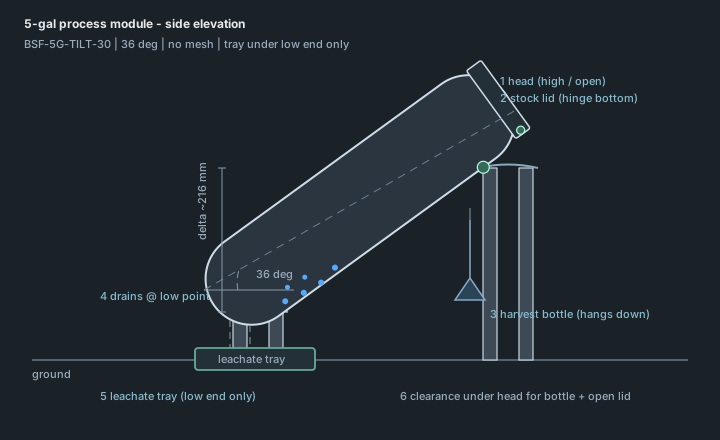
This design is an open-hardware layout for a small household—roughly one kitchen's sorted scraps (~0.5 kg/day planning band from UNEP household food-waste rates), or a first learning unit before scaling up. Geometry matches tropical field reports (e.g. Chiriquí pilots). A 5-gallon (19 L) plastic bucket or steel pail lies on its side, raised on legs, tilted 36° from horizontal. Wet feed sits in the low end; prepupae climb the interior (within the 28°–45° literature range) and drop into a collection bottle hanging under the high end near the lid. Use the lid kit (largest sub-lid the stock lip lid allows). Leachate leaves through drilled holes clustered at the low point (no interior mesh)—not the same as frass or frass tea; see leachate.
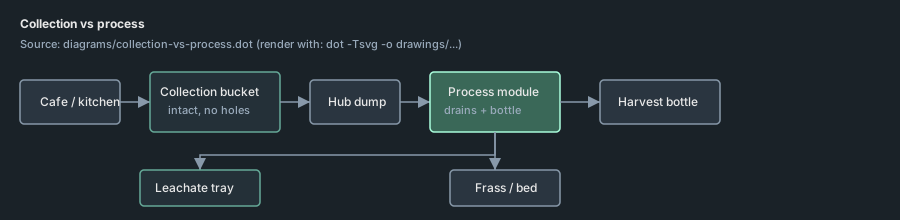
Why buckets under an open-sided roof instead of climate-controlled tray labs: buckets vs climate trays (with Boquete CapEx sketches). General rules (shade, pests, moisture) are in the tank design article. This page is the build spec for the process module (drilled drains, underside harvest, lid kit + rack-bucket adaptation)—used standalone on blocks/legs or as a rack module in the modular stack unit. Café collection buckets stay intact on pickup routes and dump into process modules at the hub.
Two bucket roles
| Role | Holes / harvest | Where it lives |
|---|---|---|
| Collection bucket | Intact lid; no drain or harvest holes | Café / kitchen route — dump at hub, wash, reuse |
Process module (BSF-5G-TILT-30) |
Drains + aeration + adult ports; underside PET bottle; lid kit + rack-bucket adaptation | Cinder-block or lumber stand, or steel rack cradle |
Same stock 5-gal SKU; different adaptation. Do not drill route pails. Cinder-block standalone is the process module plus a block stand—not a third vessel type.
Leachate tray (required companion)
Drains must empty into a catch tray or pan under the low end—not onto the patio. Standalone: a shallow tote or baking pan that slides under the drain cluster (clearance under the high end stays free for the hanging bottle and open lid). Modular stacks: per-tier drip into a column PVC drop → shared header/sump (see modular unit). Empty and rinse on a schedule; treat liquid as leachate, not frass tea.
Capacity planning
Planning default · one bucket
~0.8 kg wet feed / day (mid)
Larval capacity per bucket (how hard you can feed one module)—not how much a café generates. Shared with the modular stack unit. A typical household sorted stream (~0.5 kg/day) fits mid capacity; a café’s wet SCG alone is ~8–10 kg/day (claim) and needs a stack. Mature drums on animal tailings often run above mid; see feed profiles below.
Constants (planning defaults)
| Symbol | Value | Use |
|---|---|---|
V_nom | 19 L | Nominal 5-gal shell |
V_act | ~10 L | Active wet bed — tilted low-end pool (~50% steady fill) |
F_lo / F_mid / F_hi | 0.5 / 0.8 / 1.2 kg/day | Wet feed per bucket (lo / mid / hi band) |
Formulas: multiply module counts in the modular unit by these per-bucket values. Substrate volume ≠ daily throughput—larvae limit kg/day.
By feed profile (one tilted drum)
| Feed profile | Typical wet kg/day | Notes |
|---|---|---|
| Tier-A coffee (per module) | 0.5–0.8 | How hard to feed one bucket with SCG blend—not café generation. A café often makes ~8–10 kg wet SCG/day (claim); blend, don’t sole-diet (economy) |
| Mixed kitchen trim | 0.8–1.2 | Default F_mid–F_hi; matches ~one household sorted stream (~0.5 kg/day mid from UNEP-based planning) |
| Animal tailings (meat trim, manure-linked farm waste, chicken/pig) | 1–2+ | Larvae often thrive on these denser streams—common on farm compounds with a mature colony, often above coffee-route planning defaults (waste stream · chicken yard) |
Operators feeding dense animal trim often exceed the 0.8 kg/day mid (F_mid) line—that is expected, not a failure of the bucket. Ramp feed to observed consumption; do not size a hub from animal-trim peaks alone.
Standalone vs rack module
| Layout | Design ID | Active bed | Feed/day (lo / mid / hi) |
|---|---|---|---|
| Standalone tilted drum | BSF-5G-TILT-30 |
~10 L | 0.5 / 0.8 / 1.2 kg (+ higher on animal trim) |
| Rack module (vertical stack tier) | BSF-5G-RACK |
~8.5 L | 0.5 / 0.8 / 1.2 kg — hub counting unit |
Scale beyond one bucket: column → rack (e.g. 3 tiers ≈ 2.4 kg/day mid; double-row block ≈ 19 kg/day mid—about one restaurant’s sorted waste, claim). Town programs: municipal.
What you build
- Adaptation kits — lid kit (sub-lid in stock lip lid) + rack bucket (drains + threaded harvest). Collection shells stay undrilled.
- Stand — fastest: wedge between cinder blocks to ~36°; or lumber / welded cradles (~216 mm height delta). Pad block edges; clearance under the high end for bottle and open sub-lid.
- Feed access — lid kit on the open end (not a hatch in the barrel wall).
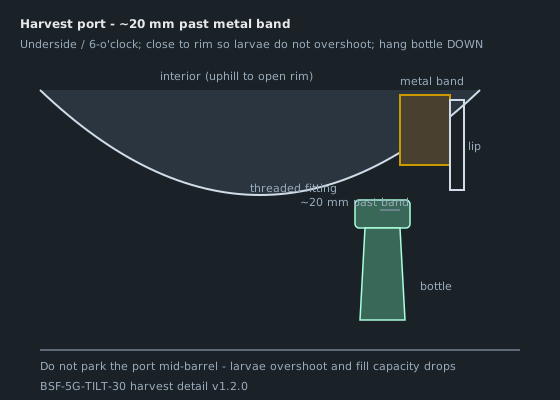
- Harvest port — threaded bottle hanging under the high end near the rim (~20 mm past the metal band).
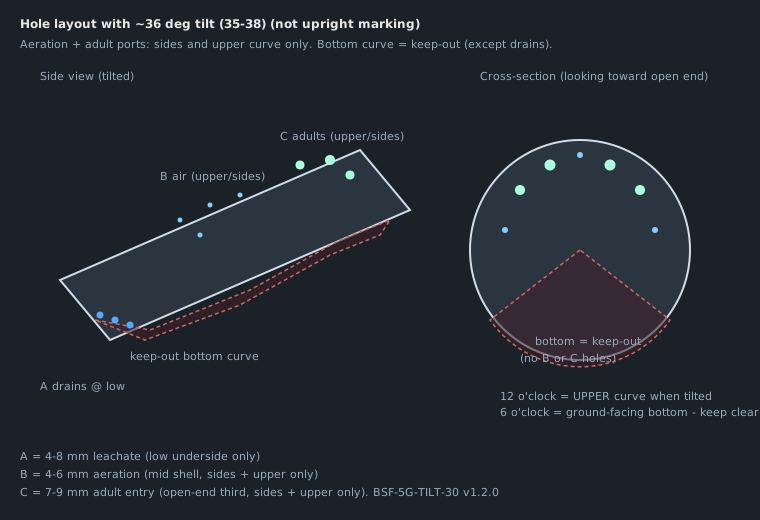
- Drainage / air / adults — low-corner drain cluster (~4–8 mm); aeration on sides and upper curve (tilted); larger adult ports (~7–9 mm, under 1 cm) in the open-end third; catch tray below; no mesh.
Schematics
Build from these drawings—not from marketing photos. Scroll the set; each figure is the measuring source.
Materials
Gather these before you cut. Optional items use unit optional or qty 0 for notes.
| Qty | Unit | Item | Spec | Notes |
|---|---|---|---|---|
| 1 | each | Vessel | 5 gal (19 L) food-grade plastic bucket OR steel pail; clean; no prior toxic contents | Used bakery buckets OK if washed; avoid unknown chemical pails |
| 1 | each | Lid kit | BSF-5G-LID completed stock lip lid with max sub-lid | See /designs/5-gallon-lid/ — do not cut hatch into barrel wall |
| 0 | note | (in lid kit) | Hinges ship with lid kit | Do not double-count |
| 1 | optional | String | Cord or twine for pull-handle / rare wind tie-down | Usually part of lid kit; optional extra |
| 1 | lot | Stand (pick one) | Cinder blocks / CMUs wedged to ~36° OR 25 mm steel tube OR 2×4 lumber frame | Blocks = fastest patio hack; pad contact edges; clear high end for bottle + hanging lid |
| 2 | optional | Cradle straps | 50 mm metal band or rope/string to blocks or U-bolts + rubber | Wide contact for plastic; string-tie OK on block nests |
| 1 | optional | Pad | Slit garden hose / rubber / cardboard on block edges | Stops point-load cracks on HDPE |
| 2 | optional | Flat-bar cradle rings (welded stand) | Upper+lower formed flat bar + push-on EPDM edge trim | Preferred over mesh basket; see modular open-cradle section |
| 1 | lot | Drain cluster | Many ~4–8 mm at geometric low point (process modules) | See rack-bucket kit; no interior mesh |
| 1 | lot | Aeration holes | Sparse ~4–6 mm on sides + upper curve when tilted (mid shell) (process) | Keep off ground-facing bottom curve—nothing should drain/fall out |
| 1 | lot | Adult entry ports | ~7–9 mm (under 10 mm) in open-end / top third on sides + upper curve (process) | Adults fly in to oviposit; never on bottom curve when at 36° |
| 1 | each | Leachate catch tray | Shallow tote / roasting pan / oil drip pan under low-end drain cluster | Required companion—not frass tea; empty/rinse on schedule; optional cloth over pan only (never inside bucket) |
| 1 | each | Harvest adapter | 28-400 PET bottle thread through UNDERSIDE ~20 mm past metal band | ~20 mm past metal band; PET 28-400 preferred |
| 1 | each | Collection bottle | 1–2 L PET bottle; bottom cut off; hangs DOWN under high end | Replace when dirty |
| 1 | roll | Sealant | Silicone (food-contact rated if available) | Harvest port only—not for drain mesh |
| 12 | each | Fasteners | M6×25 mm bolts + nylock nuts + washers | Frame and cradle |
| 1 | set | Tools | Drill; 4–9 mm bits; deburr tool; level; inclinometer | File metal burrs before use |
Optional spreadsheet download: materials.csv
Build guide
Full stand options, process-only drilling, and startup are on the build guide. Lid and shell adaptation kits: lid kit, rack bucket.
Photos (looks like this)
Illustrative only — never for measuring. Prefer schematics above. Build from drawings when this render disagrees (lid hardware especially).
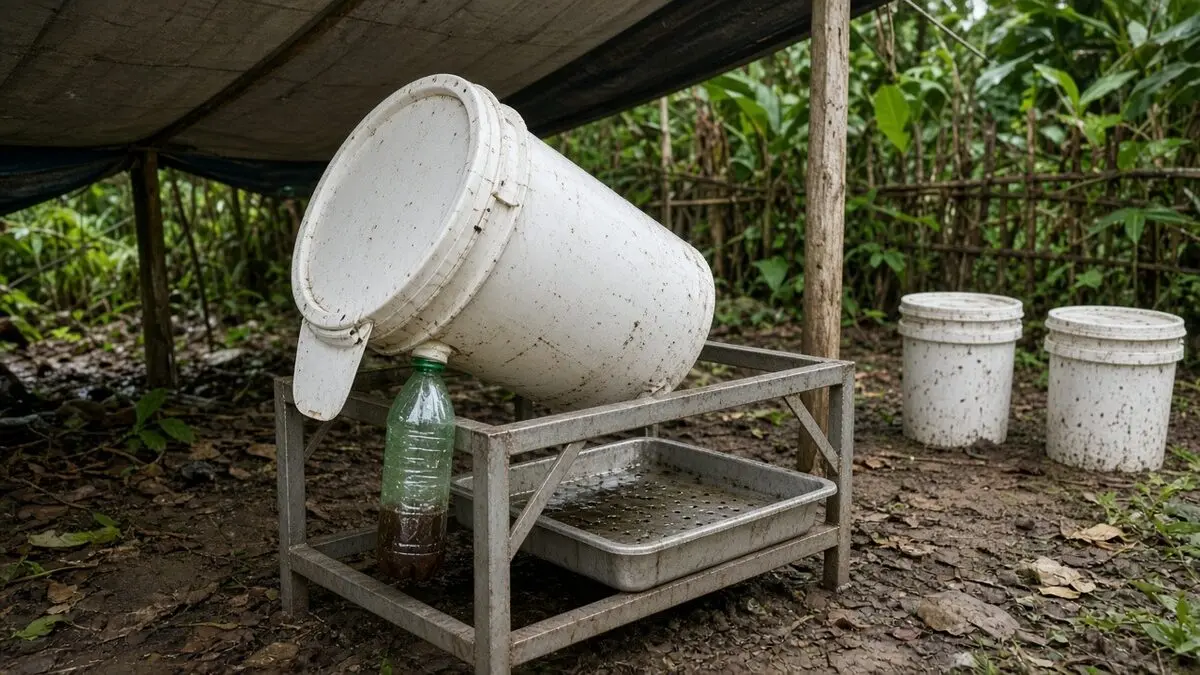
Build sequence (summary)
- Clean food-grade bucket or pail; reject unknown prior contents.
- Build a stand: cinder-block wedge, lumber, or welded frame; verify 36° ± 2° (band 35–38°); leave underside clearance at the high end.
- Process modules only: drill drains, side/upper aeration (off bottom curve when tilted), adult ports, and near-rim harvest (rack bucket guide); collection pails stay intact.
- Build the lid kit (max sub-lid; molded handle opposite hinge).
- Mount, leak-test with water, then shade and seed. Full steps: build guide.
Plastic or metal
Both work. Plastic is easier to drill; use wide cradle contact (flat-bar rings + EPDM, or padded blocks)—avoid point loads that crack HDPE. Metal needs deburred holes and rust protection outdoors. Neither belongs in open midday sun—see shelter notes. For sourcing, lifespan, and Chiriquí field prices, read tank materials.
License: CERN-OHL-P-2.0 · Design ID BSF-5G-TILT-30 · v1.3.0